


How to Publish a DBA Research Paper: A Complete Step-by-Step Guide for Business Scholars Worldwide
Imagine spending three years conducting research that could reshape how a global industry operates — only to have it sit in a folder on your desktop because you didn't know where to send it. That's the quiet tragedy of countless Doctor of Business Administration graduates every year. Publishing your DBA research paper isn't just an academic formality; it's how your intellectual labour escapes the ivory tower and lands on the desks of policymakers, business leaders, and fellow scholars who need exactly what you've discovered. If you've ever felt overwhelmed by the publication process — the jargon, the journal selection, the peer review anxiety — this guide is your map.
What Makes a DBA Research Paper Different From a Standard PhD?
Before you can publish your work effectively, you really need to get a handle on what makes your research stand out uniquely in the academic world. A Doctor of Business Administration (DBA) is a professional doctorate, so your research is set up to connect the gap between academic theory and actual business practice. And unlike a traditional PhD, which tends to focus on theoretical contribution only, a DBA research paper has to show what academics sometimes call “dual impact” — proper rigour for the scholarly community, and also relevance for practitioners, in other words, people who do the work.
That difference, honestly, matters a lot when you’re choosing where to publish and also how to frame your contribution. In business disciplines, research that manages to combine academic impact with practical usefulness is especially valued. International business research, in particular, comes out top for turning academic findings into practitioner outcomes. That conclusion is based on a study that looked across 56 journals, in 12 business disciplines, from 2000 to 2020. For DBA candidates, though, this is not some kind of restriction; it’s your competitive edge. Your years on the ground mean you can talk about problems that purely theoretical researchers often can not.
Step 1: Anchoring Your Research in a Clearly Defined Problem
The publication journey starts way before you ever write an abstract. It begins with figuring out a research problem that is both original and actually consequential. A lot of DBA candidates get snagged on this part; they pick topics that feel personally compelling, but the truth is, those same subjects sit in already crowded scholarship. You can fix that by doing a few early moves: talk with academic mentors and fellow scholars to brainstorm feasible themes, scan recent editions of top business journals for what seems missing, and also show up at academic and industry conferences to keep up with the newest directions. Together, those steps help you land on a fresh and publishable research angle, not just another reworded study.
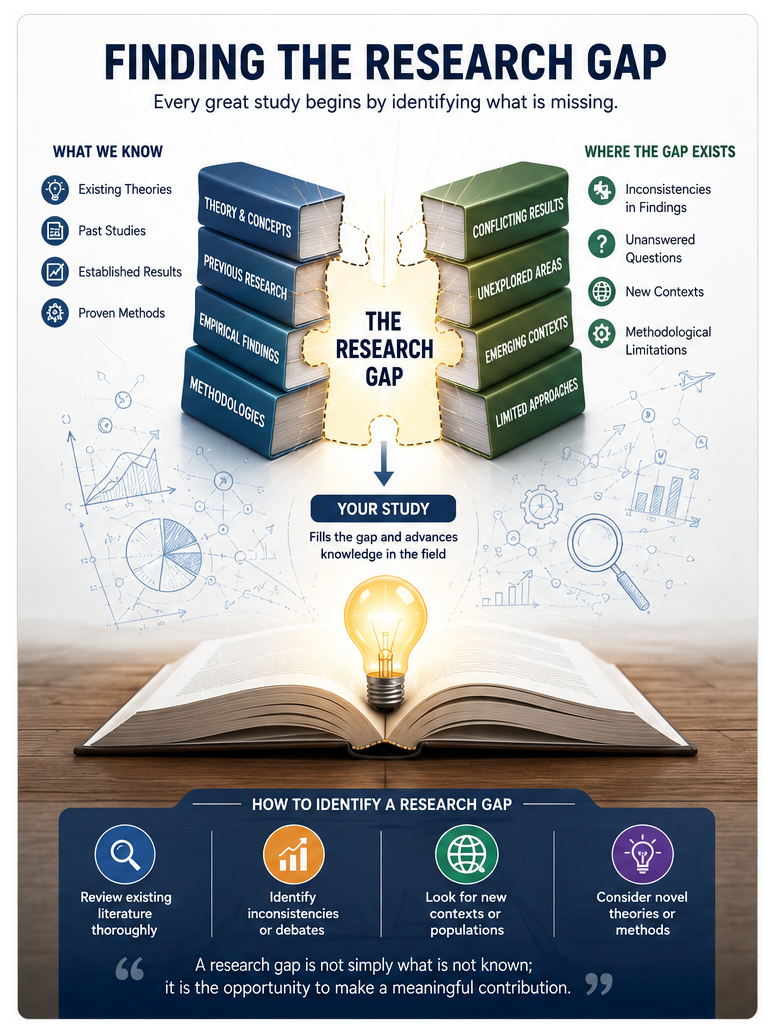
This is where the “gap” idea becomes kind of central. A gap is not merely something that has never been studied; it’s more like a place where existing results don’t agree, where day-to-day practice has moved ahead of theory, or where a specific method has never been tried in a given situation. Your DBA thesis supervisor is a major asset right here, but still don't ignore the value of mapping the landscape using databases like Scopus, Web of Science, and the Social Science Research Network (SSRN). The goal is simple: figure out what’s already been done, then locate what hasn’t been explained properly. Honestly, a well-scoped research problem is the strongest single indicator of whether a paper is likely to be accepted later on.
Step 2: Build a Literature Review That Argues, Not Summarises
A literature review in a publishable DBA paper is not, really, a catalogue of what others have produced—it’s an argument. You’re showing the reader the exact intellectual terrain, and then nudging them toward the unmarked territory where your study fits, or actually where it will land. Use only peer-reviewed sources, taken from credible databases. For DBA work, the most dependable options are Business Source Premier (EBSCO), Scopus, Web of Science, SSRN, and Google Scholar. Try for something like 60–80 peer-reviewed references for a full journal article, arranged around a single thematic logic, not a random list. The seriousness and depth of the review tell peer reviewers whether you genuinely understand the field, or if you’re just describing it from a distance.
Use only credible, peer-reviewed sources. The most reliable databases for DBA research include:
|
Database |
Strengths |
Access |
|
Business Source Premier (EBSCO) |
Full text for 2,000+ periodicals, including Harvard Business Review & Academy of Management Journal |
Institutional subscription |
|
Scopus |
Broad coverage, citation tracking, journal rankings |
Institutional subscription |
|
Web of Science |
High-impact journal indexing, citation analysis |
Institutional subscription |
|
Google Scholar |
Free access, covers theses, preprints, and grey literature |
Free |
|
SSRN (Social Science Research Network) |
Pre-publication papers, working papers in business & economics |
Free |
|
JSTOR |
Archive access to foundational business and management journals |
Partial free access |
Sources: Penn State University DBA Library Guide; Paperpal Academic Publishing Resource
Step 3: Choose Your Methodology and Defend It
Methodology is kind of the architecture of your paper, not just the routine part. A DBA paper can go quantitative, qualitative, or mixed methods, and honestly, each one does different work. The quantitative routes usually fit best when you want to test hypotheses across big sample sizes. Then there’s the qualitative way, interviews, case studies, grounded theory—those are just as credible, especially if you are trying to make sense of complex organisational behaviour or shifting leadership dynamics. No matter what you pick, your reasoning has to be very clear, not implied. Reviewers will still ask, like why is this the most suitable method for this particular question, not the other one. Also, admitting the limitations of your chosen methodology, with some honesty, is a sign of academic maturity, and editors do notice it.
Step 4: Write With Structure and Precision
That standard layout — like Abstract, Introduction, Literature Review, Methodology, Findings, Discussion, Conclusion, References — it actually comes with its own set of expectations in each stage, you know. Your abstract ( 150–250 words ) can’t just be a placeholder. It has to sit alone and work as a full summary, because editors often decide pretty quickly, based on it alone. There was research looking at 10,211 abstracts in the Journal of Business Research, covering 1973 to 2024, and it showed a pretty clear movement toward empirical studies, especially those using advanced analytical stuff such as regression, structural models, and machine learning. So yes, the discipline rewards rigour, there’s not much room for hand waving. If someone makes vague theoretical claims without any empirical anchor, it’s getting harder and harder to get those papers placed in competitive journals. In other words, the overview needs to show what you actually did, and why it matters, without relying on generalities.
Step 5: Select the Right Journal Strategically
Picking where to send your manuscript can be the most consequential call in the whole publication journey. In practice, you’ll want to ask yourself things like whether the journal is indexed in Scopus or Web of Science, how fast they usually respond, and if the readership in that place actually lines up with what your paper contributes. For solid DBA-focused outlets, you might look at the Journal of Business Research, Journal of Business Ethics, Management Decision, and International Journal of Management Reviews. Before you hit submit, study five to ten newer articles in that exact journal, because if your paper feels like it belongs there, then your odds of getting past the first editorial desk review jump a lot.
Step 6: Preparing Your Submission Package
Most journals want more than just the manuscript, actually. A full submission package usually covers the manuscript itself (put together in the journal’s exact specs), plus a cover letter, a declaration of conflicts of interest, and sometimes either a highlights document or a structured abstract. If you follow the instructions precisely, meaning everything from the referencing style, even down to font size, then you’re already ahead. And writing a compelling cover letter, which kind of argues for the paper’s weight and usefulness, is also a big piece. A good cover letter basically sets the tone, because it’s your first real pitch, before the editor turns a single page.
In the cover letter, aim for no more than three paragraphs, and make sure you spell out the research question you worked on, plus why the results are relevant to the journal’s own readership in particular, not just “in general”. Also, confirm the material is original, that it has not been published before, and that it isn’t being considered at the same time by another venue with a similar scope. Avoid using the cover letter to recount the manuscript, which should be reserved for the abstract. Instead, treat it like a small editorial brief: argue that this work belongs in your journal because it aligns with, and speaks directly to, the discussions your readers are already having.
Step 7: Treat Peer Review as a Dialogue
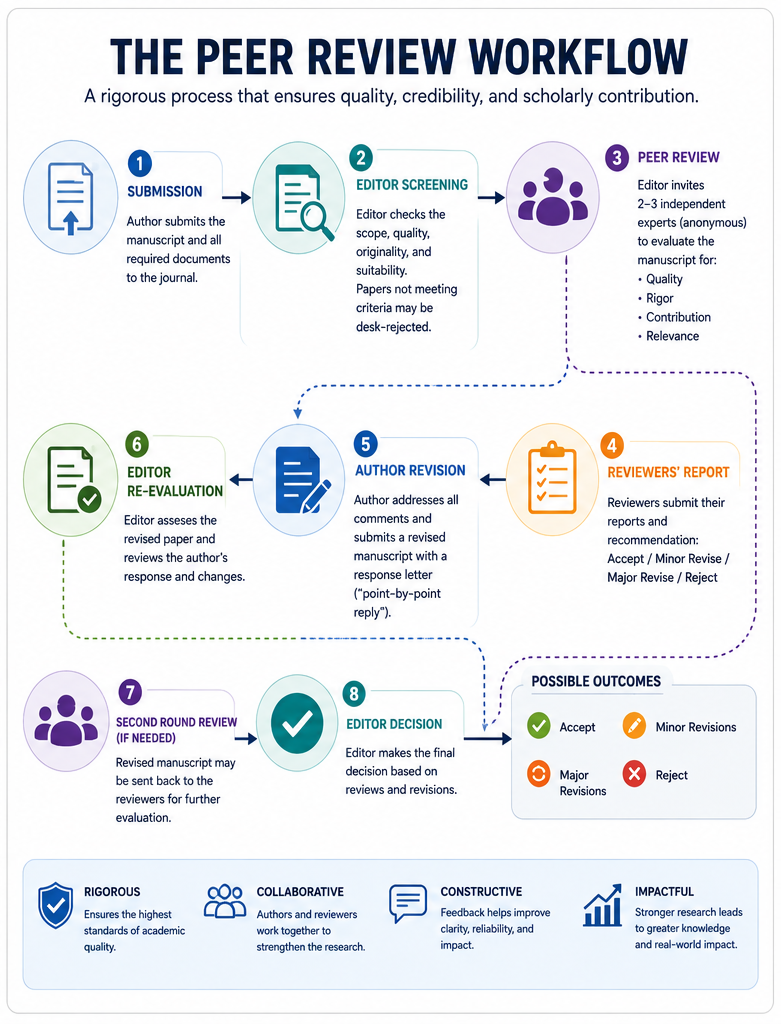
Peer review is where credible scholarship is forged, and understanding how it works demystifies the anxiety around it. Analysis of over 28,000 submissions across ICLR 2017–2025 found that the rebuttal stage is decisive: timely, substantive, and interactive author-reviewer communication strongly increases acceptance likelihood, often outweighing initial reviewer skepticism. When you receive comments, respond to every point methodically — either accepting the suggestion with a clear revision note, or respectfully disagreeing with academic justification. A "revise and resubmit" verdict is effectively good news. Treat it accordingly.
Step 8: Managing Revisions and Responding to Reviewers
When you get a revise and resubmit decision, you’re kind of entering this really intellectually demanding stretch of the publication process. At that point, you have to satisfy multiple reviewers, who can end up giving conflicting opinions while you still keep the coherence and integrity of your own original argument intact. The core idea is to produce a detailed response document, like a point-by-point reply for every single reviewer remark. In that doc, you should include the original comment, then your response, and also the exact modifications you made in the manuscript, including page and line numbers.
Also, don't rush this part. Doing a careful, thorough revision that takes eight weeks will very often give you a better result than a hurried revision sent in ten days. Editors can usually notice the difference, even when the changes look similar on the surface. And if a reviewer’s suggestion would basically weaken your research design, or add some logical inconsistency, then it’s academically appropriate to say no—politely, but with evidence—explaining why you didn’t carry it out. Reviewers are experts, not infallible authorities, and most editors really appreciate it when authors can defend their methodological decisions with confidence and clear reasoning, not just generic wording.
Step 9: Post-Publication — Making Your Research Travel
Publication is not the finish line. It is the starting gun for dissemination. A paper that sits unread in a journal archive contributes nothing to the field it was written to advance. Once your paper is published, actively share it: upload it to your institutional repository, post it on ResearchGate and Academia.edu, share the DOI link on LinkedIn, and present the findings at relevant industry conferences. Promoting your work after publication — sharing it across professional networks and academic communities — is a critical and often overlooked part of the research contribution lifecycle.
Consider also the practical implications of your findings for the business community. If your DBA research identifies, for instance, a pattern in how mid-market companies fail to implement ESG frameworks, reach out to industry associations or write a shorter practitioner-focused summary for a trade publication. The bridge between academic insight and practical application is exactly what DBA research is built to construct.
A Final Word
The path from DBA candidate to published academic author is not a straight highway — it is more like a mountain trail with unexpected switchbacks, occasional rockfalls, and stretches of remarkable clarity. What separates those who publish from those who don't is rarely raw intellectual talent. It is persistence, methodological rigour, the willingness to accept and act on critique, and a genuine belief that the world is a little better for knowing what you discovered.
Your DBA research is not just an academic exercise. It is your professional legacy. Give it the visibility it deserves.

 English
 Arabic
 French
 Spanish
 Portuguese
 Deutsch
 Dutch
Dutch
 Italiano
 Russian
 Romaian
 Portuguese (Brazil)
 Greek
Greek