


Robot Takeover? China Plans 20,000 Humanoids in 2026 While the West Watches
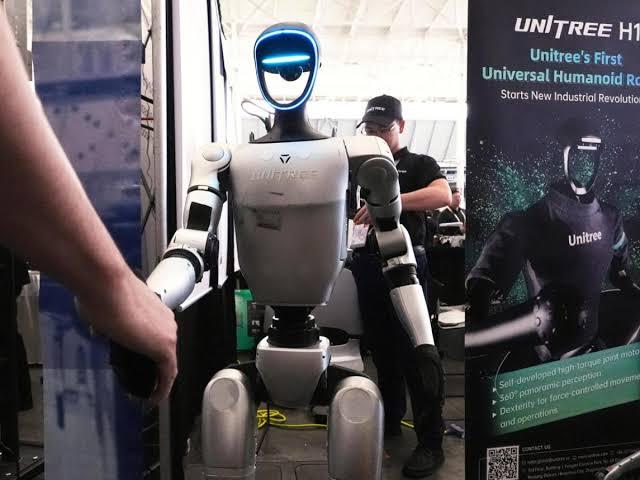
China’s robotics industry is making a bold move that’s raising eyebrows across the tech world. Chinese robotics company Unitree has announced plans to ship 20,000 humanoid robots in 2026 — a production target that could reshape the global robotics race.
But here’s the controversy: are these machines truly ready for the real world?
Technology analyst Patrick Zhang, writing in his Geopolitechs newsletter and quoted by South China Morning Post, cautioned that while robots may perform impressively on stage, real-world environments are far less forgiving.
“Robots may struggle in real-world environments, but on stage they hold all the advantages.”
Even Unitree’s leadership acknowledges the issue. CEO Wang has admitted that deploying humanoid robots outside controlled settings remains a major hurdle. The next big challenge? Giving robots a functional “brain.”
🧠 The AI Brain Race
Unitree is now partnering with other firms to develop advanced embodied AI systems — essentially creating smarter control systems that allow robots to think, adapt, and move independently in unpredictable environments.
Without that leap, mass production could outpace practical usefulness.
The question becomes:
Is China scaling too fast — or simply moving faster than everyone else?
🌍 China Expands Beyond Its Borders
Unitree isn’t alone. A wave of Chinese robotics firms is aggressively targeting global markets.
Shenzhen-based LimX Dynamics is already building partnerships in the United States after presenting its humanoid robot at CES. Founder Will Zhang made it clear that the company’s strategy isn’t just about funding:
“More than money, I’m focused on local partnerships.”
LimX has already secured its first foreign investor from the Middle East and plans to begin shipments there this year — part of a broader strategy to establish overseas influence through collaboration.
⚔️ Tesla vs. China: A Robotics Showdown
While Chinese firms accelerate production, Western competitors appear to be moving more cautiously.
Tesla, for example, is targeting a late-2027 release for its humanoid robot, Optimus.
Yet by 2025, global humanoid robot shipments had already reached roughly 13,000 units — and Chinese companies such as Agibot and Unitree accounted for nearly 80% of that total.
That dominance prompted Morgan Stanley to double its 2026 sales forecast for China to 28,000 units — signaling what analysts believe is a rapid shift from research prototypes to industrial-scale production.
🚨 Industrial Breakthrough — or Overhyped Momentum?
Here’s the tension:
Robots still struggle in chaotic, real-world conditions.
Yet production is scaling at unprecedented speed.
China is exporting aggressively while Western firms refine cautiously.
Is this a technological leap — or a strategic gamble?
If Unitree delivers 20,000 humanoids in 2026, it won’t just be a milestone for robotics. It could mark the moment China takes the lead in one of the most transformative industries of the century.
And if that happens, the global balance of technological power may quietly shift — one humanoid at a time.

 English
 Arabic
 French
 Spanish
 Portuguese
 Deutsch
 Turkish
 Dutch
Dutch
 Italiano
 Romaian
 Portuguese (Brazil)
 Greek
Greek