


OSI vs TCP/IP Model: A Complete Guide to Network Architecture and Communication Layers
In the world of computer networking, understanding how data travels from one device to another is fundamental. Two of the most important models that explain this process are the OSI (Open Systems Interconnection) Model and the TCP/IP Model. These frameworks provide a structured approach to networking, helping professionals design, troubleshoot, and optimize communication systems efficiently.
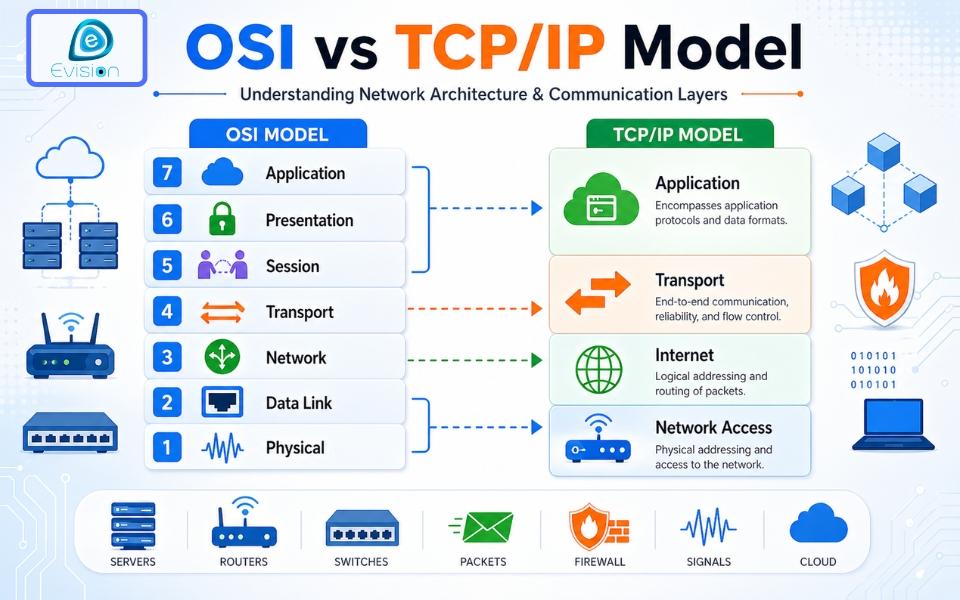
The OSI Model is a conceptual framework divided into seven layers: Physical, Data Link, Network, Transport, Session, Presentation, and Application. Each layer has a specific role in the data transmission process. Starting from the Physical layer, which deals with hardware and signal transmission, to the Application layer, where end-user interactions occur, the OSI Model ensures a clear separation of responsibilities. This layered approach makes it easier to identify issues, standardize network operations, and understand how different networking technologies interact with each other.
On the other hand, the TCP/IP Model, also known as the Internet Model, is a more practical and widely implemented framework consisting of four layers: Network Interface, Internet, Transport, and Application. Unlike the OSI Model, which is mainly theoretical, the TCP/IP Model is used in real-world networking, including the internet. It simplifies the networking process by combining some of the OSI layers, making it more efficient and easier to implement.
One of the key differences between the OSI and TCP/IP models lies in their structure and functionality. While the OSI Model clearly separates presentation and session functions into distinct layers, the TCP/IP Model integrates these functions into the Application layer. Similarly, the Physical and Data Link layers of OSI are combined into the Network Interface layer in TCP/IP. Despite these differences, both models serve the same purpose: ensuring reliable and efficient communication across networks.
Understanding these models is essential for anyone working in IT, networking, or cybersecurity. They provide a foundation for learning advanced concepts such as routing, switching, network security, and protocol design. By mastering the OSI and TCP/IP models, professionals can better analyze network issues, design scalable architectures, and implement secure communication systems.
In conclusion, the OSI and TCP/IP models are the backbone of modern networking. While the OSI Model offers a detailed and theoretical perspective, the TCP/IP Model provides a practical approach used in everyday internet communication. Together, they form the basis of how data is transmitted across networks, making them essential knowledge for both beginners and experienced professionals in the field of networking.

 English
 Arabic
 French
 Portuguese
 Deutsch
 Turkish
 Dutch
Dutch
 Italiano
 Russian
 Romaian
 Portuguese (Brazil)
 Greek
Greek