


Advanced Authorization Scheme Benefits That Could Transform Your Business
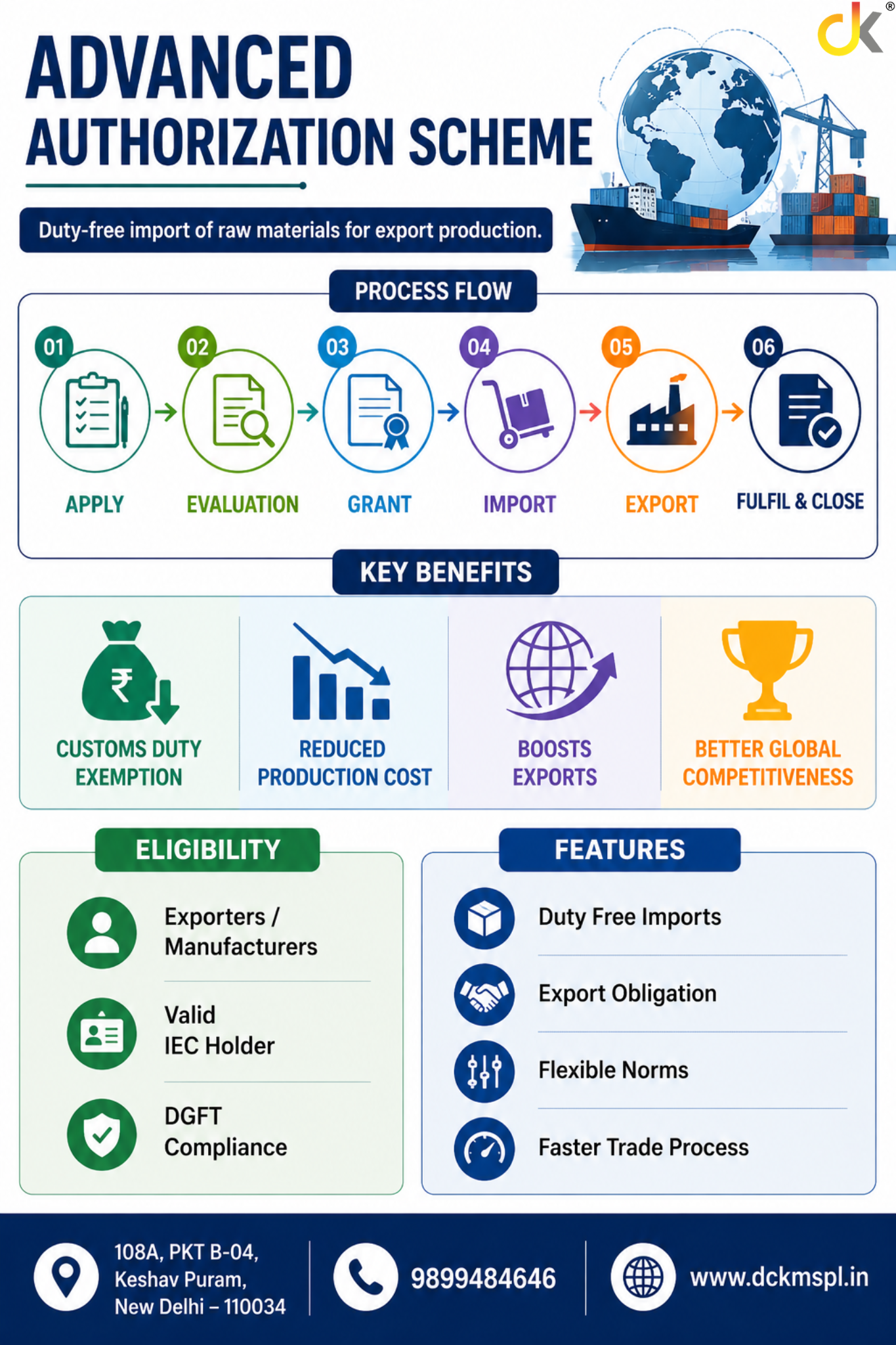
If your business is engaged in international trade, understanding the advance authorization scheme is no longer optional — it is a strategic necessity. The advance authorization scheme allows eligible exporters to import raw materials, inputs, and components duty-free, provided they fulfil specified export obligations. For businesses looking to reduce operational costs, stay compliant with trade regulations, and gain a competitive edge in global markets, this scheme is one of the most powerful tools available under India's Foreign Trade Policy.
In this blog, we break down the key benefits, regulatory framework, and how leveraging this scheme can genuinely transform your business.
What Is the Advance Authorization Scheme?
The advance authorisation scheme is issued under the Foreign Trade Policy (FTP) by the Directorate General of Foreign Trade (DGFT). It permits the duty-free import of inputs that are physically incorporated into the export product, along with fuel, oil, energy, and catalysts that are consumed or utilised in the production process.
Under the advance authorisation scheme under GST, the holder is also exempt from Integrated GST (IGST) and Compensation Cess on imports, subject to certain conditions. This makes the scheme particularly attractive for manufacturers and exporters who deal in large volumes of imported raw materials.
Key features of the scheme include:
-
Duty-free import of inputs directly used in export production
-
Exemption from Basic Customs Duty, Additional Customs Duty, and anti-dumping duties (where applicable)
-
Applicability for physical exports, intermediate supplies, and deemed exports
-
Available to both manufacturer exporters and merchant exporters
Export Obligation Under Advance Authorization: What You Need to Know
One of the most critical aspects of this scheme is the export obligation under advance authorisation. When an authorization is issued, the holder is legally bound to fulfil a specific export commitment within a defined time period — typically 18 months from the date of issue.
Failing to meet the export obligation can result in:
-
Recovery of customs duties with interest
-
Penalty proceedings under the Customs Act
-
Adverse impact on future licence eligibility
To avoid these risks, businesses must maintain meticulous records of imports, production cycles, and export documentation. Proper tracking of SION (Standard Input Output Norms) or self-declared norms is also essential for accurate compliance reporting.
Understanding your export obligation upfront and planning your production and logistics accordingly is not just best practice — it is a legal requirement.
Export Advance Authorization Scheme: Unlocking Competitive Advantage
The export advance authorisation scheme is specifically designed to enhance the competitiveness of Indian exporters in global markets. By eliminating customs duties on inputs, exporters can price their products more aggressively and improve profit margins simultaneously.
Here is how the scheme delivers measurable business value:
-
Cost Reduction: Duty savings on imported inputs can be substantial, directly improving your landed cost and product pricing.
-
Cash Flow Improvement: Avoiding upfront duty payments frees up working capital that can be deployed elsewhere in operations.
-
Market Competitiveness: Lower production costs allow exporters to compete more effectively with international players in price-sensitive markets.
-
Compliance Credibility: Holding an active advance authorization demonstrates regulatory credibility with overseas buyers and financial institutions.
-
Wider Product Scope: The scheme covers a broad range of sectors — from textiles and engineering to chemicals and pharmaceuticals.
For mid-to-large scale exporters, the cumulative financial benefit of the export advance authorisation scheme across multiple product lines can run into crores annually.
Advance Authorisation Scheme UPSC Perspective: Why Policy Matters for Business
From a policy standpoint — often discussed under advance authorisation scheme UPSC topics — this scheme sits at the intersection of trade policy, foreign exchange management, and export promotion. Understanding its policy rationale helps businesses anticipate regulatory changes and align their trade strategies proactively.
The scheme is governed by:
-
Foreign Trade Policy (FTP) – Updated periodically by the DGFT
-
Customs Act, 1962 – Governs duty-free import conditions
-
GST Laws – Define IGST exemptions linked to advance authorisation
-
FEMA Regulations – Applicable in cases involving foreign exchange obligations
Staying updated with policy revisions ensures that your business remains compliant and continues to benefit from the latest incentive structures without disruption.
Read More - How Export Advance Authorisation Scheme Helps Indian Exporters Save Duties
How Our Programs Support Your Advance Authorization Journey
Navigating the advance authorization scheme requires expertise across documentation, compliance, and regulatory filings. Our comprehensive suite of services is designed to support businesses at every stage of the trade lifecycle:
-
Import Export Consultancy Programs – Expert guidance on eligibility, application strategy, and scheme selection
-
IEC Registration Assistance – Fast-track your Importer Exporter Code (IEC) registration with DGFT
-
DGFT Compliance Programs – End-to-end support for all DGFT filings, including advance authorisation applications
-
Coal Import Monitoring System (CIMS) Registration – Seamless CIMS compliance for coal importers
-
Steel Import Monitoring Support (SIMS) – Dedicated support for steel sector import monitoring
-
Export Documentation Programs – Accurate and timely preparation of shipping bills, invoices, and certificates of origin
-
Customs Compliance Support – Assistance with customs assessments, duty drawback, and bond management
-
License & Registration Assistance – Help with EPC registration, RCMC, and other trade licences
-
Trade Advisory Programs – Strategic advisory on FTP benefits, preferential trade agreements, and sector-specific schemes
-
End-to-End Import Export Solutions – A single-window solution for all your international trade compliance needs
Conclusion
The advance authorization scheme is not merely a duty exemption mechanism — it is a transformative tool that can fundamentally reshape your cost structure, compliance posture, and competitive positioning in global trade. However, its full potential can only be unlocked when businesses approach it with the right knowledge, documentation discipline, and regulatory awareness.
Our brand is committed to empowering exporters and importers with the expertise, tools, and end-to-end support they need to navigate India's complex trade framework with confidence. Whether you are applying for advance authorisation for the first time or looking to optimise an existing programme, our team of trade specialists is here to guide you every step of the way.
Reach out to us today and let us help you turn compliance into competitive advantage.
Frequently Asked Questions (FAQs)
Q1. Who is eligible to apply for the advance authorization scheme?
Any manufacturer exporter or merchant exporter with a valid IEC (Importer Exporter Code) and an export order or Letter of Credit (LC) is eligible to apply for advance authorisation under the Foreign Trade Policy.
Q2. What is the validity period of an advance authorisation?
An advance authorisation is typically valid for 12 months for import purposes and carries an export obligation period of 18 months from the date of issue, extendable under specific conditions.
Q3. How does the advance authorisation scheme under GST work?
Under the GST framework, advance authorisation holders are exempt from paying IGST and Compensation Cess on imports of inputs, provided the imports are linked to genuine export production and all prescribed conditions are met.
Q4. What happens if export obligations are not fulfilled?
Non-fulfilment of export obligation under advance authorisation leads to recovery of the customs duties that were exempted, along with applicable interest and possible penalty proceedings under relevant laws.
Q5. Can the advance authorization scheme be used for deemed exports? Yes. The scheme is applicable not only for physical exports but also for intermediate supplies and deemed exports as defined under the Foreign Trade Policy.
Q6. What is the difference between advance authorisation and EPCG scheme? Advance authorisation covers duty-free import of inputs used in export production, while the Export Promotion Capital Goods (EPCG) scheme covers the import of capital goods at concessional or zero duty for export production. Both schemes have separate export obligations and eligibility criteria.

 English
 Arabic
 French
 Spanish
 Portuguese
 Turkish
 Dutch
Dutch
 Italiano
 Russian
 Romaian
 Portuguese (Brazil)
 Greek
Greek