


Best EdTech CRM Software to Streamline Student Enrollment in 2026
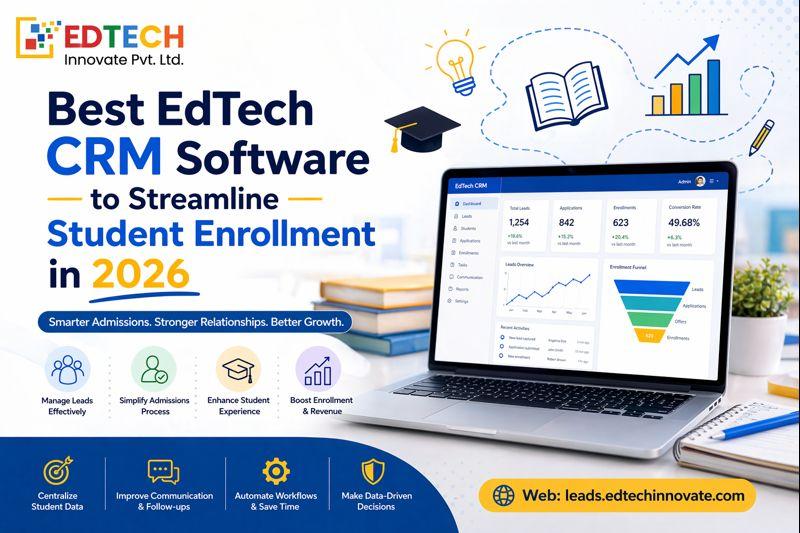
The education sector is becoming increasingly competitive as schools, universities, coaching institutes, and online learning platforms work to attract and convert student inquiries into enrollments. Managing admissions manually often leads to delayed follow-ups, scattered student data, and lower conversion rates. As the volume of leads increases, institutions need efficient digital systems to manage admissions effectively.
This is where EdTech CRM software becomes essential. It helps education businesses capture leads, automate follow-ups, centralize student data, and improve communication across the enrollment journey.
In this article, we will explore how CRM software helps streamline student enrollment in 2026, what features institutions should look for, and why adopting the right system can significantly improve admissions performance.
Why Student Enrollment Needs Better Management
Student enrollment is one of the most critical functions in the education sector. Institutions often receive inquiries from multiple channels such as:
- Websites
- Social media
- Email campaigns
- Calls
- Referral programs
Without an organized system, admission teams may face:
- Missed leads
- Delayed responses
- Manual errors
- Poor follow-up
- Low conversion rates
These challenges directly impact enrollment performance and revenue growth.
Efficient admission management systems help institutions handle these processes with greater accuracy and speed.
Best EdTech CRM Software to Streamline Student Enrollment in 2026
Education-focused CRM systems are designed to manage the complete student admission journey from inquiry to enrollment.
They help institutions:
- Capture student leads
- Automate workflows
- Track admissions
- Improve student communication
- Generate admission insights
These features help improve conversion rates while reducing manual workload.
1. Centralized Lead Management
Educational institutions receive leads from multiple channels, making manual tracking difficult.
A CRM centralizes all student inquiries in one dashboard so admission teams can:
- Track lead sources
- Assign counselors
- Monitor inquiry status
- Avoid missed leads
This improves lead visibility and helps teams respond faster.
Solutions like HubSpot CRM provide centralized lead management capabilities that support admission workflows.
2. Automated Follow-Up Processes
Timely follow-ups are crucial for converting student inquiries into admissions.
CRM software automates follow-up actions such as:
- Welcome emails
- Admission reminders
- Counselor assignments
- Application updates
Automation reduces delays and keeps prospective students engaged throughout the process.
3. Improved Student Communication
Personalized communication improves student trust and engagement.
A CRM stores important student details, including:
- Course interests
- Interaction history
- Inquiry stage
This enables institutions to send relevant messages and improve student experience.
For example, students interested in business programs can automatically receive targeted updates related to those courses.
Platforms such as Salesforce Education Cloud help institutions manage personalized communication effectively.
4. Real-Time Enrollment Tracking
Admission teams need visibility into where each applicant stands in the enrollment journey.
CRM dashboards allow teams to track whether students have:
- Submitted applications
- Uploaded documents
- Paid fees
- Confirmed enrollment
This transparency improves coordination and helps prioritize high-potential leads.
5. Data-Driven Decision Making
Admission performance improves when institutions use data to guide decisions.
CRM analytics provide insights into:
- Lead sources
- Conversion rates
- Campaign performance
- Counselor productivity
These insights help optimize marketing and admission strategies for better results.
Key Features to Look for in EdTech CRM Software
Choosing the right CRM solution requires evaluating the features most relevant to educational institutions.
1. Multi-Channel Lead Capture
The CRM should collect inquiries from websites, ads, calls, and social platforms.
This ensures all leads are tracked centrally.
2. Workflow Automation
Automation for repetitive tasks improves efficiency.
Important workflows include:
- Lead assignment
- Email triggers
- Reminder notifications
3. Reporting and Analytics
Detailed reporting helps institutions measure enrollment performance and improve strategies.
4. Communication History Tracking
Every student interaction should be stored to ensure smooth follow-up.
5. Integration Capabilities
The CRM should integrate with:
- Admission forms
- Payment systems
- Email platforms
- Marketing tools
Solutions such as Zoho CRM provide these integrations for streamlined operations.
Benefits of Using CRM for Student Enrollment
Institutions that adopt CRM systems gain several benefits.
1. Higher Conversion Rates
Fast responses and automated follow-ups improve inquiry-to-enrollment conversions.
2. Increased Team Productivity
Automation reduces repetitive tasks, allowing counselors to focus on student engagement.
3. Better Student Experience
Students receive timely, personalized communication.
4. Improved Visibility
Admission teams gain clear visibility into the enrollment funnel.
5. Scalable Admission Processes
Institutions can manage increasing inquiry volumes without expanding manual effort.
Challenges of Manual Admission Management
Institutions that rely on spreadsheets or manual systems often face:
1. Lost Leads
Leads can be overlooked or forgotten.
2. Delayed Follow-Ups
Slow communication reduces student interest.
3. Poor Data Visibility
Tracking admissions becomes difficult.
4. Limited Reporting
Manual systems provide little actionable insight.
These inefficiencies reduce enrollment success.
Future of CRM in Education
Education technology is evolving rapidly.
Future CRM systems will increasingly use:
- AI-driven lead scoring
- Predictive analytics
- Automated student journeys
- Personalized engagement workflows
Platforms like Microsoft Dynamics 365 are already integrating AI features that improve lead prioritization and student engagement.
As competition grows, institutions that adopt advanced CRM solutions will gain a strong advantage.
Choosing the Right CRM for Your Institution
Before selecting a CRM, institutions should assess:
1. Enrollment Volume
Choose software that matches inquiry volume.
2. Workflow Complexity
Evaluate automation needs.
3. Budget
Select a scalable solution within budget.
4. Ease of Use
The system should be user-friendly for admission teams.
These considerations help institutions select software that aligns with operational goals.
Conclusion
Managing student admissions effectively is essential for education businesses seeking growth in 2026. Manual systems often create delays, inefficiencies, and missed opportunities that reduce enrollment success.
The right CRM software streamlines admissions by centralizing leads, automating workflows, improving communication, and delivering actionable insights. These capabilities improve conversion rates, increase staff productivity, and enhance the student experience.
For institutions looking to scale admissions and improve enrollment performance, adopting the best EdTech CRM software is no longer optional—it is a strategic necessity.
FAQs
1. What is EdTech CRM software?
It is a customer relationship management system designed to manage student leads, admissions, and communication.
2. How does CRM improve student enrollment?
It automates follow-ups, centralizes leads, and improves communication for better conversion rates.
3. Can small institutions use CRM software?
Yes, many CRM platforms are scalable for institutions of all sizes.
4. What features are important in education CRM?
Lead capture, workflow automation, reporting, and communication tracking are essential.
5. Which CRM platforms are popular for education businesses?

 English
 Arabic
 Spanish
 Portuguese
 Deutsch
 Turkish
 Dutch
Dutch
 Italiano
 Russian
 Romaian
 Portuguese (Brazil)
 Greek
Greek