


Inside Modern Cookware Material Engineering
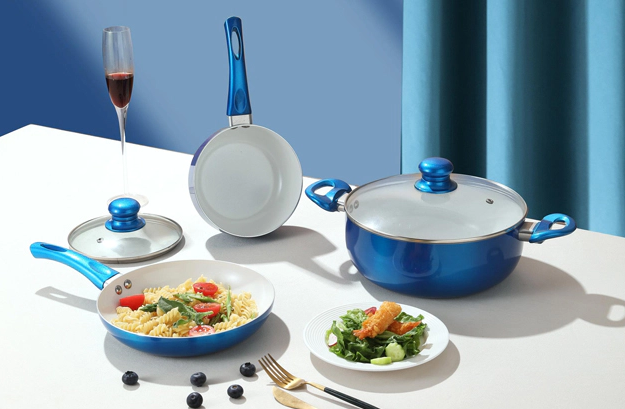
The evolution of Cooking Pots And Pans is closely tied to advances in material engineering. Today’s cookware integrates multiple metals and coatings to optimize heat conduction, durability, and corrosion resistance.
Common material types include:
Stainless Steel
Thermal conductivity: ~14–16 W/m·K
Composition: iron + 10–20% chromium + nickel
Advantage: high corrosion resistance and durability
Aluminum
Thermal conductivity: ~205 W/m·K
Lightweight density: ~2.7 g/cm³
Advantage: rapid heat response
Cast Iron
Thermal conductivity: ~35–45 W/m·K
Heat retention: very high thermal mass
Density: ~7.2 g/cm³
In modern Cooking Pots And Pans, layered construction is standard. A typical 5-ply pan may include alternating stainless steel and aluminum layers totaling 2.5–4.0 mm thickness. This improves lateral heat spread and reduces thermal gradients.
Surface engineering is equally important. Nonstick coatings are applied in micro-layer systems:
Primer layer for adhesion
Intermediate ceramic or polymer base
Top fluoropolymer or ceramic finish
Coating thickness usually ranges between 20–50 microns.
Thermal cycling durability is tested in industrial conditions by repeating:
Heating to 250°C
Rapid cooling cycles
Mechanical abrasion tests
High-quality cookware must withstand thousands of cycles without delamination or warping greater than 0.3 mm deviation across the base.
From a manufacturing standpoint, stamping, spinning, and forging processes determine structural density and grain alignment, which directly influence durability.
Cooking Pots And Pans are therefore engineered products combining metallurgy, surface chemistry, and thermal physics.

 English
 French
 Spanish
 Portuguese
 Deutsch
 Turkish
 Dutch
Dutch
 Italiano
 Russian
 Romaian
 Portuguese (Brazil)
 Greek
Greek