


Modern Insurance Underwriting: Leveraging Data and Risk Intelligence for Smarter Decisions
The Data Revolution in Insurance Underwriting
Insurance underwriting has historically been a discipline grounded in actuarial science — the application of statistical methods to historical loss data to predict future claim frequencies and severities. This approach has served the industry well for over a century, providing the pricing and risk selection framework that makes the pooling of risk commercially viable. But the data revolution of the past decade has transformed what is possible in underwriting far beyond what actuarial methods based on historical loss data alone can deliver.
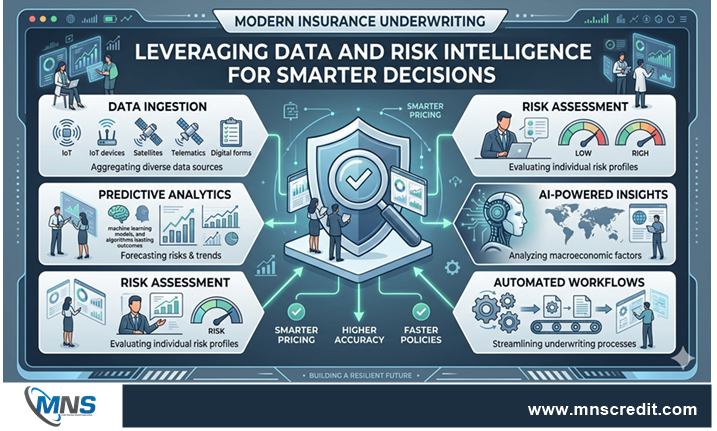
Modern insurance underwriting leverages an expanded and continuously refreshing evidence base — combining traditional actuarial data with real-time risk signals, behavioural analytics, external verification data, and machine learning models — to make decisions that are simultaneously faster, more accurate, and more responsive to individual risk characteristics than any previous underwriting methodology. The implications for pricing accuracy, adverse selection management, fraud prevention, and portfolio performance are substantial.
The Expanding Data Universe in Insurance
The most transformative development in modern insurance underwriting is the dramatic expansion of the data available to inform risk decisions. In commercial insurance, this expanded data universe includes financial performance data drawn from filed accounts and Business Information Reports, corporate compliance and director history from registry databases, industry-specific risk indicators, supply chain and payment behaviour data, and — increasingly — real-time operational data from IoT sensors, telematics devices, and connected infrastructure.
For property and casualty risks, geospatial data, climate models, and satellite imagery now allow underwriters to assess location-specific risk exposures with a precision that historical loss data for any individual location could never support. For liability risks, adverse media monitoring, regulatory action databases, and litigation history data provide signals about management quality and risk culture that self-reported application information cannot capture. For financial lines, Financial Ratios trend analysis and payment behaviour data from trade credit sources reveal the financial stability of the insured in ways that are directly relevant to directors and officers, professional indemnity, and credit risk coverage.
Machine Learning: Pricing Precision at Scale
Traditional actuarial rating models are linear — they combine rating factors according to fixed weights derived from historical loss analysis. Machine learning models are non-linear — they can identify complex interactions between risk factors that linear models miss, and weight those interactions dynamically based on the specific combination of characteristics present in each risk. The practical result is pricing that is more precisely calibrated to actual individual risk, with less cross-subsidisation between genuinely different risk profiles that happens to share similar characteristics on the dimensions captured by traditional rating variables.
Better pricing precision improves portfolio economics in two directions simultaneously. It reduces adverse selection by accurately identifying and pricing higher-risk exposures that traditional models underprice — making them less attractive to write at those prices. And it improves competitive positioning on better risks that traditional models overprice — enabling more competitive premiums that attract a higher proportion of the lower-risk business that insurers most want.
Automated Underwriting for High-Volume Lines
In high-volume commercial lines — SME property, commercial motor, trade credit — the combination of expanded data access and machine learning-based risk scoring enables fully automated underwriting for a significant proportion of applications. Automated systems can ingest application data, verify key facts against external sources, calculate risk scores, apply rating models, and generate policy terms within seconds — handling the majority of standard applications without human intervention.
This automation delivers efficiency gains that fundamentally change the economics of high-volume commercial underwriting: lower processing cost per policy, faster turnaround times that improve broker and customer satisfaction, and consistent application of rating criteria that eliminates the variation introduced by individual underwriter judgment across large volumes of similar risks. Human underwriters are freed from routine processing to focus on complex, non-standard, or large-value risks where their expertise and contextual judgment genuinely add value.
Risk Intelligence for Portfolio Management
Modern underwriting is not just about making better decisions on individual risks — it is about managing the portfolio of risks as a coherent whole. Risk intelligence platforms that aggregate data across the underwriting portfolio enable management to monitor concentration risk in specific sectors, geographies, or risk types; track the emerging performance of different segments of the book; identify the early warning signals of deteriorating risk quality before they materialise in elevated claims; and model the impact of different macroeconomic scenarios on portfolio performance.
This portfolio intelligence dimension of modern underwriting is particularly valuable in lines where risk correlations are significant — where multiple risks in the portfolio are affected by the same adverse event simultaneously, creating loss aggregation that is far larger than the sum of individual risk exposures. Climate risk concentration, cyber risk accumulation, and sector-specific liability trends are all dimensions of portfolio risk that modern risk intelligence tools are specifically designed to identify and manage.
Conclusion
Modern insurance underwriting, powered by expanded data, machine learning analytics, automated processing, and portfolio risk intelligence, is delivering a qualitative improvement in underwriting outcomes that was not achievable with the tools available even five years ago. Insurers that invest in building these capabilities — or in accessing them through partnerships with data and technology providers — are writing better risks, pricing them more accurately, processing them more efficiently, and managing their portfolios more intelligently than those that remain reliant on traditional methods. In insurance, as in all risk disciplines, better information and better analytics produce better outcomes.

 English
 Arabic
 French
 Spanish
 Portuguese
 Deutsch
 Dutch
Dutch
 Italiano
 Russian
 Romaian
 Portuguese (Brazil)
 Greek
Greek