


Indoor Farming Market innovations shaping climate-resilient food production models
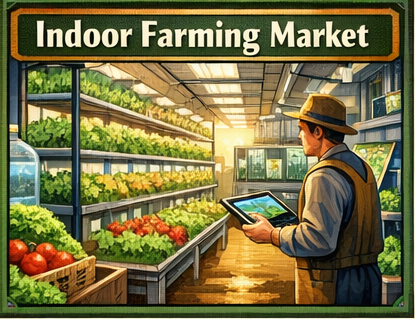
Indoor farming is rapidly transforming how food is produced, distributed, and consumed, particularly as global populations rise and climate unpredictability intensifies. By leveraging advanced technologies and data-driven systems, this approach offers a reliable alternative to traditional agriculture, ensuring consistent crop yields regardless of external environmental conditions. As urbanization accelerates and arable land becomes increasingly scarce, indoor farming is gaining recognition as a critical component of future food systems.
The Evolution of Controlled Environment Agriculture
At the core of modern indoor farming lies controlled environment agriculture, a system that enables growers to regulate temperature, humidity, light, and nutrient delivery with precision. This approach minimizes external risks such as pests, extreme weather, and soil degradation. Over the past few years, innovations in automation, artificial intelligence, and IoT sensors have elevated controlled environment agriculture into a highly optimized and scalable solution.
One of the most notable advancements is the integration of smart monitoring systems that provide real-time insights into plant health. These systems use predictive analytics to adjust growing conditions dynamically, reducing resource waste while maximizing productivity. As sustainability becomes a central concern, controlled environment agriculture is also evolving to use renewable energy sources and closed-loop water systems, significantly lowering environmental impact.
Vertical Farming and Urban Food Security
Vertical farming has emerged as a defining trend within indoor farming, especially in densely populated urban areas. By stacking crops in multiple layers within compact indoor spaces, vertical farming maximizes output per square meter, making it ideal for cities where land is limited. This method not only reduces transportation costs but also ensures fresher produce for consumers.
The rise of vertical farming is closely tied to the increasing demand for locally grown, pesticide-free food. Urban consumers are becoming more conscious of food origins, pushing retailers and governments to invest in localized production systems. Additionally, vertical farming facilities are now being integrated into commercial buildings, warehouses, and even residential complexes, signaling a shift toward decentralized food production.
Another important aspect is energy efficiency. While vertical farming relies heavily on indoor grow lights, advancements in LED technology have significantly reduced energy consumption. Modern indoor grow lights are designed to emit specific light spectra that enhance photosynthesis, resulting in faster growth cycles and higher crop yields. This technological progress is making vertical farming more economically viable than ever before.
Hydroponic Farming and Resource Optimization
Hydroponic farming is a cornerstone of indoor farming systems, offering a soil-free method of cultivating plants using nutrient-rich water solutions. This technique allows for precise control over nutrient delivery, leading to faster growth and higher productivity compared to traditional soil-based methods. Hydroponic farming is particularly valuable in regions with poor soil quality or limited water availability.
One of the key advantages of hydroponic farming is its efficiency in water usage. Compared to conventional agriculture, it uses significantly less water due to recirculation systems that minimize waste. This makes it an attractive solution in water-scarce regions and aligns with global sustainability goals.
In recent years, hybrid systems combining hydroponic farming with vertical farming structures have gained traction. These integrated models optimize both space and resource utilization, making them highly effective for commercial-scale production. Furthermore, automation technologies are being incorporated into hydroponic systems, enabling remote management and reducing labor costs.
Technology, Investment, and Market Outlook
The rapid growth of indoor farming is being fueled by substantial investments from both private and public sectors. Governments are increasingly recognizing the role of indoor farming in ensuring food security and are offering incentives to encourage adoption. At the same time, venture capital firms are investing heavily in startups focused on innovative farming technologies.
A growing trend is the use of artificial intelligence to optimize crop cycles and predict yields. AI-powered platforms analyze data from sensors, cameras, and environmental controls to make informed decisions, improving efficiency and reducing operational risks. Robotics is also playing a significant role, particularly in tasks such as planting, harvesting, and packaging.
Additionally, advancements in indoor grow lights continue to drive the industry forward. New lighting systems are not only more energy-efficient but also customizable, allowing growers to tailor light conditions to specific crops. This level of precision enhances both quality and yield, further strengthening the business case for indoor farming.
In the midst of these developments, the market outlook remains highly promising. Mentioning in research report by Grand View Research, the global indoor farming market size is anticipated to reach USD 119.70 billion by 2033, growing at a CAGR of 11.3% from 2026 to 2033. This projection reflects the increasing adoption of indoor farming technologies across various regions, driven by the need for sustainable and resilient food production systems.
This growth trajectory can be attributed to several factors, including rising consumer demand for organic produce, technological advancements, and the increasing frequency of climate-related disruptions. As traditional agriculture faces mounting challenges, indoor farming is positioned as a reliable alternative that can deliver consistent results.
Moreover, the integration of renewable energy sources such as solar and wind power is expected to further enhance the sustainability of indoor farming operations. Companies are also exploring circular economy models, where waste from one process is reused in another, creating a more efficient and environmentally friendly system.
In conclusion, indoor farming is no longer a niche concept but a rapidly evolving sector with the potential to reshape global agriculture. Through innovations in vertical farming, hydroponic farming, indoor grow lights, and controlled environment agriculture, this approach addresses some of the most pressing challenges facing food production today. As technology continues to advance and investment flows increase, indoor farming is set to play a pivotal role in building a more sustainable and secure food future.

 English
 Arabic
 Spanish
 Portuguese
 Deutsch
 Turkish
 Dutch
Dutch
 Italiano
 Russian
 Romaian
 Portuguese (Brazil)
 Greek
Greek