


How Are Lab Grown Diamonds Made?
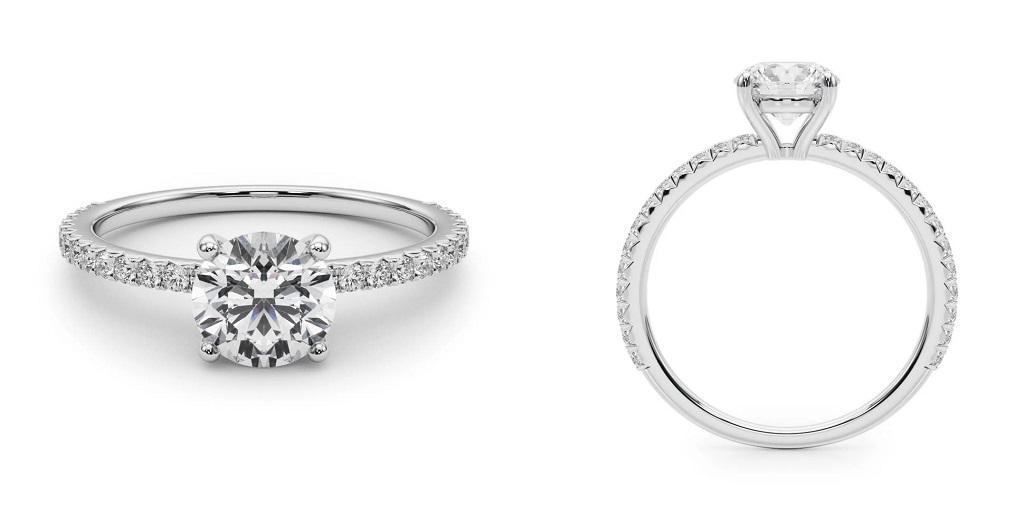
Looking at a collection of lab grown diamond engagement rings, you might wonder how they’re even made in the first place.
Well, it doesn’t take millions to billions of years under the earth, as in the case of natural diamonds. There are two main ways in which lab grown diamonds are made, both of which will be covered here.
HPHT
HPHT stands for “high pressure, high temperature” and is a method for producing lab grown diamonds that somewhat closely matches the natural processes that produce diamonds in the earth.
HPHT is a technique popular in America and China, which uses presses and carbon to make the diamonds.
The process typically uses carbon powder, usually an allotrope of carbon such as graphite. A small diamond “seed” is placed in a sealed chamber with this carbon powder and a metallic solvent, and extreme heat and pressure are applied.
Typically, the temperatures in the chamber range from 2300℉ to as high as 2900℉, and the chamber is subjected to extreme pressures as well, usually as high as 1.5 million pounds per square inch.
These temperatures and pressures dissolve the powder in the chamber and force it to form around the diamond seed, slowly creating a larger lab-grown diamond.
The process of HPHT typically takes a few weeks to a few days to complete the creation of the diamond within, which is actually an impressively short timeline considering how long it takes diamonds to form within the earth.
CVD
CVD stands for chemical vapor deposition and is another fairly common process by which lab grown diamonds are made.
The process of CVD also entails the use of a small seed diamond which is then placed inside a sealed chamber that is full of a gas. A carbon-rich gas, such as methane, is used, as the carbon donated from the gas is what accretes into the diamond.
The vacuum chamber is then sealed and heated, typically with microwave energy, which excites the gasses within, causing it to ionize, which allows it to release its carbon atoms. As the concentration of carbon in the chamber increases, the carbon accretes around the diamond seed and a larger diamond grows.
Sometimes, additional pressure and temperature are used in CVD to encourage the formation of larger diamonds if the process requires it.
Like HPHT, CVD usually takes a few weeks, and in the case of producing larger diamonds, it can take a month or more.
Why Lab Grown Diamonds?
Regardless of whether the lab grown diamonds in question were produced using CVD or HPHT, they are physically indistinguishable from natural diamonds. In other words, they are real diamonds.
In addition to the fact that they are literally real, fans of lab grown diamonds also point out that they:
- Are generally considerably more affordable than natural diamonds.
- Can be more sustainably produced than natural diamonds.
- Take less time to produce and there is no real scarcity
- And are not associated with the same ethical and environmental concerns as natural diamonds.
Explore Timeless Lab Grown Diamond Engagement Rings
Given the fact that lab grown diamond engagement rings are made with real diamonds in every sense of the word, there are some truly beautiful, stunning examples out there. Perhaps no better illustration of this can be found than the catalog offered by Mikado Diamonds.
Immerse yourself in their collection of lab grown diamond engagement rings. Available in a wide range of cuts and settings, Mikado’s lab grown engagement rings offer something for every taste.
For More Information About Natural Loose Diamond and Ready To Ship Engagement Rings Please Visit: Mikado Diamonds.

 English
 Arabic
 French
 Spanish
 Portuguese
 Deutsch
 Turkish
 Dutch
Dutch
 Russian
 Romaian
 Portuguese (Brazil)
 Greek
Greek