


Machine Learning Deployment Services Bridge Development and Production
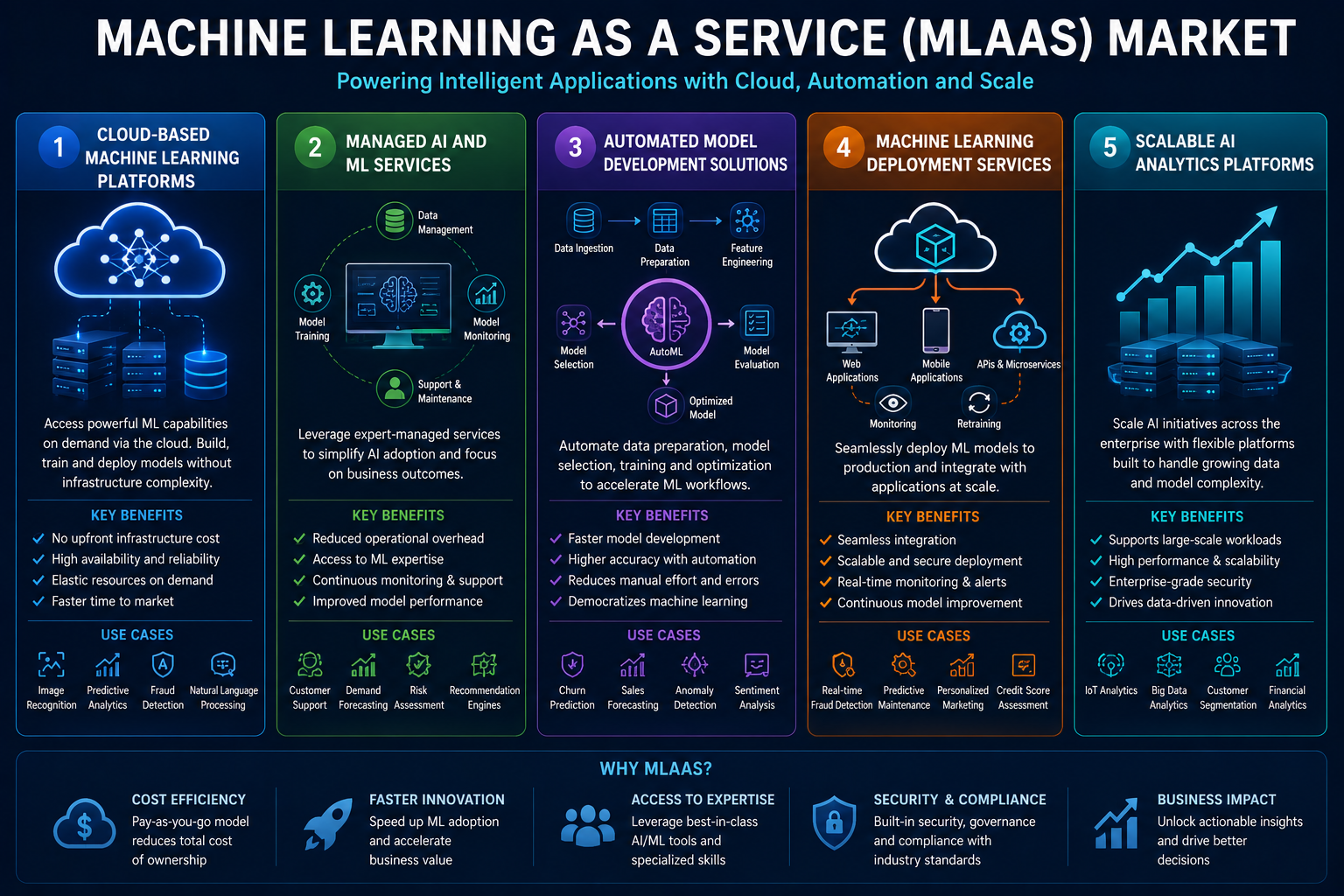
Building a machine learning model is only half the work. Deploying it so that other systems can use it is often more difficult. According to a market report from Market Research Future (MRFR), Machine Learning Deployment Services and Automated Model Development Solutions are addressing the deployment challenge. Deployment services provide infrastructure and workflows for taking trained models and making them available as prediction endpoints; automated development solutions ensure that models are production-ready.
The gap between development and deployment has been called the "last mile" problem of machine learning. A data scientist builds a model in a notebook. Deploying it requires containerization, API development, scaling infrastructure, monitoring, and versioning. Deployment services automate these tasks.
What Machine Learning Deployment Services Provide
Machine learning deployment services provide several capabilities. Model packaging automatically containers the model and its dependencies into a deployable artifact. Endpoint creation provisions HTTP endpoints that accept prediction requests and return responses. Autoscaling automatically adjusts the number of serving instances based on request volume. Versioning manages multiple model versions, enabling canary deployments (testing new models on a percentage of traffic) and rollback. Monitoring tracks prediction latency, error rates, and data drift. A/B testing routes traffic to multiple models to compare performance.
A logistics company might use deployment services to serve a delivery time prediction model. The data scientist trains the model using automated development. The deployment service packages the model, creates an endpoint, and configures autoscaling from zero to fifty instances. The company's routing system calls the endpoint for each delivery, receiving a predicted arrival time. The deployment service monitors that 99.9 percent of predictions complete within 100 milliseconds.
The MRFR report notes that deployment services are often the most critical component for organizations that have moved beyond experimentation. A model that never gets deployed creates no business value. Deployment services ensure that models actually make it into production.
Automated Model Development Solutions for Production-Ready Models
Automated model development solutions contribute to deployment readiness by producing models that meet production requirements. They can optimize models for inference latency, reducing size and complexity while maintaining accuracy. They can generate model cards that document training data, performance metrics, and limitations. They can produce models in standard formats (ONNX, TensorFlow SavedModel, PyTorch TorchScript) that are compatible with deployment services.
An e-commerce company might use automated development with a latency constraint: the recommendation model must make predictions in under 20 milliseconds. The automated solution searches for models that meet this constraint, preferring simpler architectures that are faster to evaluate. The resulting model is small enough to run on the company's existing infrastructure.
The MRFR report emphasizes that accuracy is not the only metric that matters in production. Latency, throughput, memory usage, and power consumption are also important. Automated development solutions that optimize for these constraints alongside accuracy produce models that are more deployable.
Deployment Patterns
Machine learning deployment services support multiple deployment patterns. Online prediction (synchronous) accepts a request and returns a prediction immediately. This pattern is used for real-time applications like fraud detection or recommendation. Batch prediction (asynchronous) processes many requests at once, returning results later. This pattern is used for overnight scoring or reporting. Streaming prediction processes requests from message queues, used for event-driven applications.
A financial services firm might use online prediction for fraud detection (each transaction scored in milliseconds), batch prediction for credit risk (all applications scored overnight), and streaming prediction for trade surveillance (market data processed as it arrives). The same deployment service supports all three patterns.
Model Monitoring and Data Drift
Models that perform well in development may degrade in production because the data changes. This phenomenon is called data drift. Machine learning deployment services include monitoring that detects data drift and alerts when model performance declines.
An insurance company might deploy a claims fraud model that works well for six months. Then a new type of fraud emerges. The deployment service detects that the model's predictions are increasingly uncertain, and that the distribution of input features has changed. The service alerts the data science team, who retrain the model with new data.
The MRFR report recommends automated retraining when drift is detected. The deployment service triggers the automated development solution to retrain the model on recent data, tests the new model against a holdout set, and deploys it if performance is adequate. The entire loop is automated.
Security and Access Control
Deployment services include security features to protect models and data. API authentication requires credentials for each prediction request. Network isolation restricts which systems can call the endpoint. Encryption protects data in transit. Auditing logs all prediction requests for compliance.
A healthcare organization might deploy a patient risk prediction model with strict security. Only authorized clinical systems have API credentials. All predictions are encrypted and logged. The audit log documents each prediction for regulatory review.
Conclusion
Deployment is where machine learning creates business value. Machine Learning Deployment Services provide the infrastructure and workflows to move models from development to production reliably. Automated Model Development Solutions ensure that models are optimized for production constraints. Together, they close the last mile of machine learning.


 English
 Arabic
 Spanish
 Portuguese
 Deutsch
 Turkish
 Dutch
Dutch
 Italiano
 Russian
 Romaian
 Portuguese (Brazil)
 Greek
Greek