


Beyond the Car: How Cargo Bicycle Transportation Is Redefining Family and Commercial Mobility
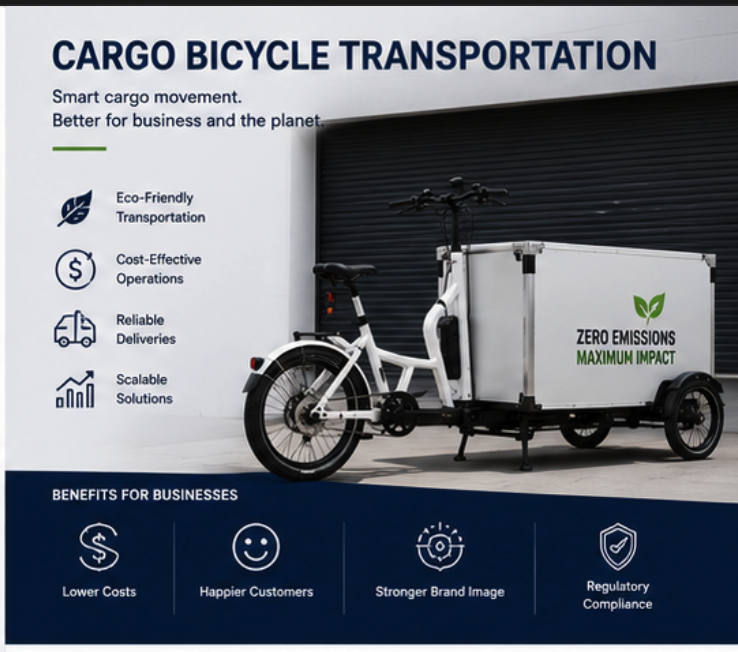
For generations, the car has been the default solution for moving people and goods. But a growing number of families, businesses, and municipalities are discovering that a well-designed bicycle can do much of the same work—at a fraction of the cost and environmental impact. Cargo Bicycle Transportation is emerging as a genuine alternative to motor vehicles for a surprising range of trips: school runs, grocery shopping, tool transport, and package delivery. Leading this movement are robust Last-Mile Delivery Bikes, which combine carrying capacity with urban agility.
The Family Car Replacement
One of the most transformative applications of cargo bicycle transportation is family mobility. A typical school run involves a single parent driving a multi-passenger vehicle a few miles, carrying one or two children and perhaps a backpack. This is profoundly inefficient—a 2,000 kg machine moving 50 kg of payload.
Enter the longtail cargo bike. With seats for two children on the rear rack, plus a front basket for bags, a longtail replaces the school run car trip entirely. The parent arrives at school having exercised, rather than having idled in traffic. The children enjoy the fresh air. No parking stress. No emissions.
For families replacing a second car with a cargo bike, the savings are substantial. The average American spends $12,000 annually on car ownership (payment, insurance, fuel, maintenance). A $4,000 cargo bike pays for itself in four months. Over a decade, the savings exceed $100,000.
Cargo Bicycle Transportation also transforms errands. A front-loader with a large wooden box can carry a week's worth of groceries, including bulky items like toilet paper and cat litter. With panniers and a cargo rack, the capacity rivals a small car's trunk.
The Commercial Application
On the commercial side, Last-Mile Delivery Bikes are revolutionizing how goods reach customers. The last mile—the final leg of a package's journey from distribution hub to doorstep—is the most expensive and emission-intensive portion of logistics. Diesel vans idling in traffic, circling for parking, and blocking bike lanes are the norm.
Cargo bikes flip this model. A delivery bike can navigate directly to the destination, park at the curb, and complete the drop in seconds. For businesses with high stop density (bakeries, pharmacies, food delivery, courier services), the efficiency gains are transformative.
Consider a local bakery delivering fresh bread to 30 cafes. A van might take 4 hours due to parking constraints. A cargo bike, using bike lanes and parking directly at each cafe, completes the route in 2.5 hours. The bakery saves fuel, vehicle costs, and labor—and the bread arrives fresher.
Design Diversity for Different Missions
Cargo bicycle transportation encompasses several distinct designs, each optimized for specific use cases:
| Design Type | Best For | Payload Capacity | Typical Wheelbase |
|---|---|---|---|
| Longtail | Family transport, groceries | 100-150 kg | Extended |
| Front-loader | Bulky goods, multiple children | 150-200 kg | Long |
| Trike (two wheels front) | Heavy, stable freight | 200-300 kg | Very long |
| Box trike | Parcel delivery, tools | 150-250 kg | Long |
Last-Mile Delivery Bikes increasingly favor the box trike design, which offers a large, flat cargo area and three-wheel stability. The rider can carry multiple parcels organized by stop, reducing sorting time at each delivery.
Infrastructure for a Bike-Based City
For cargo bicycle transportation to scale, cities must invest in appropriate infrastructure. This includes:
-
Wide bike lanes: Cargo bikes need 1.5-2 meters of width, compared to 1 meter for standard bikes.
-
Curb management: Designated cargo bike loading zones near commercial buildings.
-
Secure parking: Overnight storage for commercial fleet bikes, ideally with charging for electric-assist models.
-
Low-stress intersections: Protected intersections that separate bikes from turning trucks.
Leading cities are already implementing these measures. Paris has created over 1,000 cargo bike parking spaces. Utrecht, Netherlands, has a multi-story bicycle parking garage with dedicated cargo bike bays. London's Cycleway network includes wide lanes designed for freight bikes.
Overcoming Barriers
Despite its advantages, cargo bicycle transportation faces barriers to mass adoption:
-
Perception: Many still view bikes as toys, not serious transport tools.
-
Weather: Rain, snow, and heat reduce comfort and ridership.
-
Security: Expensive cargo bikes are targets for theft.
-
Hills: Steep terrain limits human-powered options.
Solutions exist for each barrier. Covered cargo bikes with rain canopies address weather. GPS trackers and heavy locks deter theft. And for hills, electric-assist cargo bikes (retaining human power but adding a motor) flatten gradients.
Conclusion
Cargo Bicycle Transportation is not a niche hobby—it is a practical, economical, and sustainable alternative to motor vehicles for a wide range of trips. Families replacing second cars save tens of thousands of dollars. Businesses switching to Last-Mile Delivery Bikes improve efficiency and reduce emissions. As cities invest in bike infrastructure, the shift from four wheels to two will accelerate. The cargo bike is coming to a street near you.

 Arabic
 French
 Spanish
 Portuguese
 Deutsch
 Turkish
 Dutch
Dutch
 Italiano
 Russian
 Romaian
 Portuguese (Brazil)
 Greek
Greek