


Hypervisor Explained: Types, Working Mechanism, and Key Differences Between Type 1 and Type 5
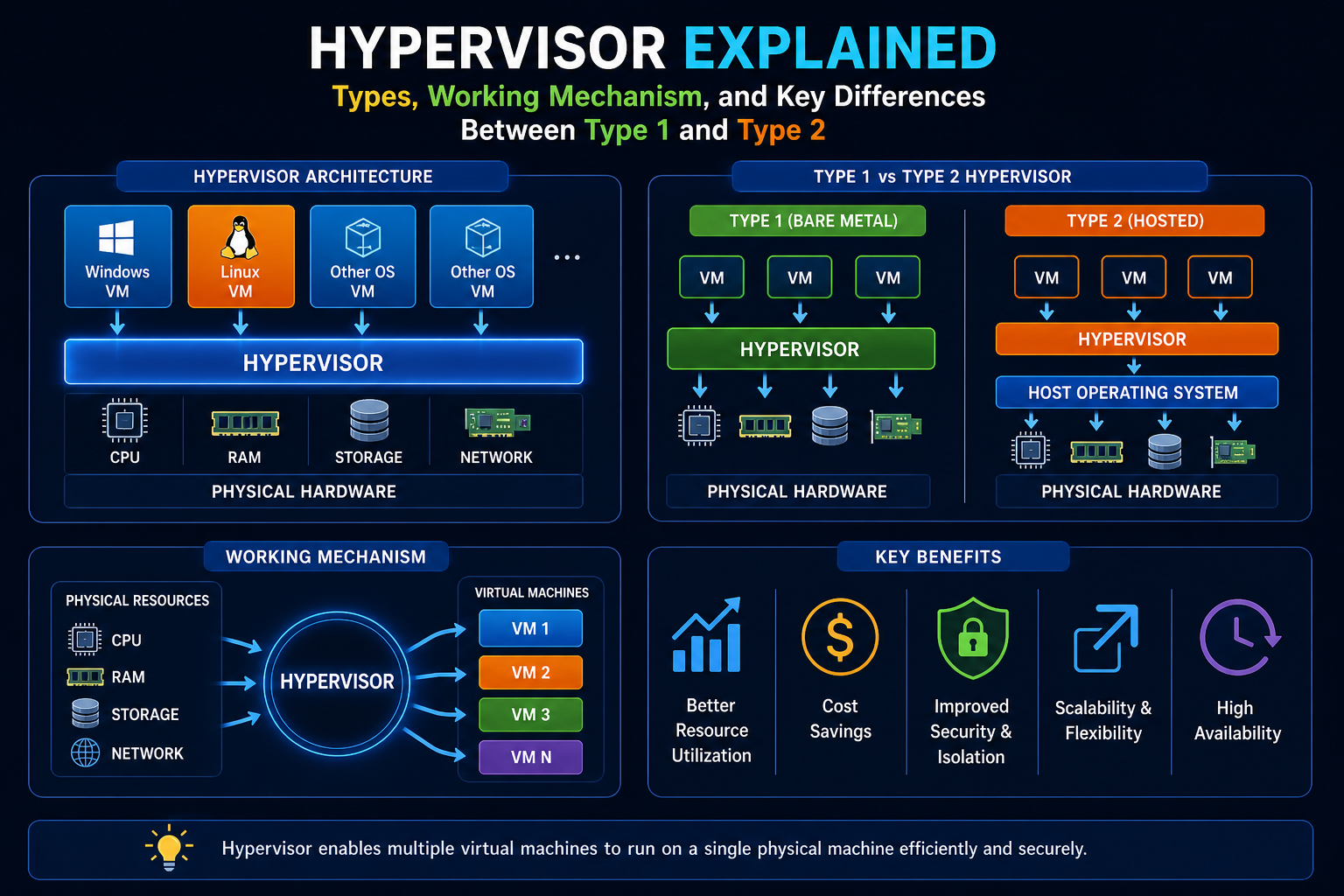
In today’s digital era, virtualization has become a backbone of modern IT infrastructure, and at the heart of this technology lies the hypervisor. But what exactly is a hypervisor, and why is it so important? This comprehensive guide will help you understand the concept, types, working mechanism, and the crucial differences between Type 1 and Type 2 hypervisors.
A hypervisor, also known as a Virtual Machine Monitor (VMM), is a software or firmware layer that enables multiple operating systems to run simultaneously on a single physical machine. It creates and manages virtual machines (VMs) by abstracting the underlying hardware resources such as CPU, memory, storage, and network. This allows better resource utilization, scalability, and cost efficiency.
Hypervisors are mainly categorized into two types: Type 1 (Bare-Metal Hypervisor) and Type 2 (Hosted Hypervisor). A Type 1 hypervisor runs directly on the physical hardware without the need for a host operating system. This makes it highly efficient, secure, and suitable for enterprise environments and data centers. Popular examples include VMware ESXi and Microsoft Hyper-V.
On the other hand, a Type 2 hypervisor runs on top of an existing operating system, just like a regular software application. It is easier to install and use, making it ideal for beginners, developers, and testing environments. Examples include VMware Workstation and Oracle VirtualBox.
Understanding how a hypervisor works is key to grasping virtualization. It allocates physical resources to virtual machines, ensures isolation between them, and manages communication between the hardware and the VMs. This isolation improves security and stability, as issues in one VM do not affect others.
When comparing Type 1 vs Type 2 hypervisors, the main differences lie in performance, security, and use cases. Type 1 offers better performance and is widely used in cloud computing and enterprise servers, while Type 2 is more user-friendly and commonly used for development, testing, and learning purposes.
Whether you are an IT student, system administrator, or tech enthusiast, understanding hypervisors is essential for mastering virtualization and cloud technologies. This guide provides a clear and structured explanation to help you build a strong foundation in this critical domain.

 English
 Arabic
 French
 Spanish
 Portuguese
 Deutsch
 Turkish
 Italiano
 Russian
 Romaian
 Portuguese (Brazil)
 Greek
Greek