



As artificial intelligence adoption accelerates across industries, deep learning has become one of the most in-demand skills for aspiring machine learning engineers, data scientists, and AI developers. For beginners entering this field, one question stands out from the start: PyTorch or TensorFlow?
These two frameworks sit at the center of modern deep learning and support applications ranging from neural networks and computer vision to natural language processing (NLP), generative AI, predictive analytics, and large language models (LLMs). While both frameworks offer powerful capabilities, they differ in learning experience, development workflow, deployment options, and industry usage.
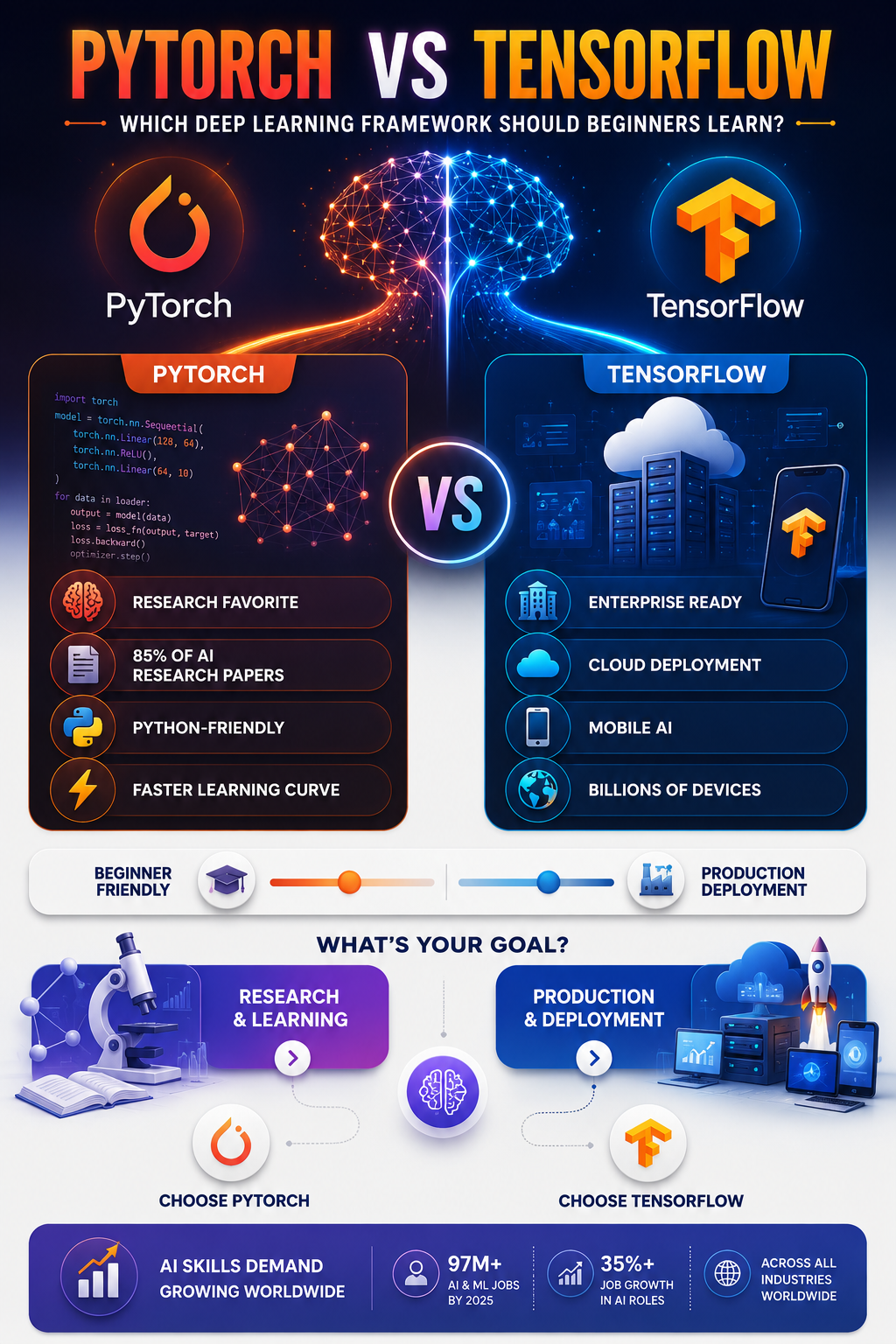
PyTorch has gained remarkable traction within the AI community and is now the leading framework for research and experimentation. Recent studies indicate that nearly 85% of deep learning research papers use PyTorch, reflecting its widespread adoption among researchers and academic institutions. Its Python-centric design, dynamic computation graph, and intuitive coding environment make it an appealing choice for beginners learning machine learning and deep learning concepts.
TensorFlow, developed by Google, continues to hold a strong position in enterprise machine learning and large-scale deployment. Industry reports suggest that TensorFlow accounts for nearly 38% of the production AI market, making it one of the most widely adopted frameworks for cloud-based machine learning, mobile applications, and enterprise AI solutions. TensorFlow Lite also powers AI deployment across billions of devices worldwide.
Growing investment in artificial intelligence has fueled demand for professionals skilled in both frameworks. PyTorch continues to expand its presence across research labs, open-source communities, and AI-focused roles, while TensorFlow remains a preferred choice for organizations building and managing large-scale machine learning systems.
For newcomers, PyTorch offers a straightforward path to understanding neural networks and model development. TensorFlow excels in deployment, model serving, and production-ready machine learning infrastructure. Whether your goal is deep learning research, machine learning engineering, computer vision, NLP, or generative AI development, learning either framework can help build valuable expertise in one of today's fastest-growing technology domains. For more details visit : https://www.skillschool.co.in/courses/free-data-science-certification-training
These two frameworks sit at the center of modern deep learning and support applications ranging from neural networks and computer vision to natural language processing (NLP), generative AI, predictive analytics, and large language models (LLMs). While both frameworks offer powerful capabilities, they differ in learning experience, development workflow, deployment options, and industry usage.
PyTorch has gained remarkable traction within the AI community and is now the leading framework for research and experimentation. Recent studies indicate that nearly 85% of deep learning research papers use PyTorch, reflecting its widespread adoption among researchers and academic institutions. Its Python-centric design, dynamic computation graph, and intuitive coding environment make it an appealing choice for beginners learning machine learning and deep learning concepts.
TensorFlow, developed by Google, continues to hold a strong position in enterprise machine learning and large-scale deployment. Industry reports suggest that TensorFlow accounts for nearly 38% of the production AI market, making it one of the most widely adopted frameworks for cloud-based machine learning, mobile applications, and enterprise AI solutions. TensorFlow Lite also powers AI deployment across billions of devices worldwide.
Growing investment in artificial intelligence has fueled demand for professionals skilled in both frameworks. PyTorch continues to expand its presence across research labs, open-source communities, and AI-focused roles, while TensorFlow remains a preferred choice for organizations building and managing large-scale machine learning systems.
For newcomers, PyTorch offers a straightforward path to understanding neural networks and model development. TensorFlow excels in deployment, model serving, and production-ready machine learning infrastructure. Whether your goal is deep learning research, machine learning engineering, computer vision, NLP, or generative AI development, learning either framework can help build valuable expertise in one of today's fastest-growing technology domains. For more details visit : https://www.skillschool.co.in/courses/free-data-science-certification-training
As artificial intelligence adoption accelerates across industries, deep learning has become one of the most in-demand skills for aspiring machine learning engineers, data scientists, and AI developers. For beginners entering this field, one question stands out from the start: PyTorch or TensorFlow?
These two frameworks sit at the center of modern deep learning and support applications ranging from neural networks and computer vision to natural language processing (NLP), generative AI, predictive analytics, and large language models (LLMs). While both frameworks offer powerful capabilities, they differ in learning experience, development workflow, deployment options, and industry usage.
PyTorch has gained remarkable traction within the AI community and is now the leading framework for research and experimentation. Recent studies indicate that nearly 85% of deep learning research papers use PyTorch, reflecting its widespread adoption among researchers and academic institutions. Its Python-centric design, dynamic computation graph, and intuitive coding environment make it an appealing choice for beginners learning machine learning and deep learning concepts.
TensorFlow, developed by Google, continues to hold a strong position in enterprise machine learning and large-scale deployment. Industry reports suggest that TensorFlow accounts for nearly 38% of the production AI market, making it one of the most widely adopted frameworks for cloud-based machine learning, mobile applications, and enterprise AI solutions. TensorFlow Lite also powers AI deployment across billions of devices worldwide.
Growing investment in artificial intelligence has fueled demand for professionals skilled in both frameworks. PyTorch continues to expand its presence across research labs, open-source communities, and AI-focused roles, while TensorFlow remains a preferred choice for organizations building and managing large-scale machine learning systems.
For newcomers, PyTorch offers a straightforward path to understanding neural networks and model development. TensorFlow excels in deployment, model serving, and production-ready machine learning infrastructure. Whether your goal is deep learning research, machine learning engineering, computer vision, NLP, or generative AI development, learning either framework can help build valuable expertise in one of today's fastest-growing technology domains. For more details visit : https://www.skillschool.co.in/courses/free-data-science-certification-training
0 Comments
0 Shares
201 Views
0 Reviews



 Arabic
 French
 Spanish
 Portuguese
 Deutsch
 Turkish
 Dutch
Dutch
 Italiano
 Russian
 Romaian
 Portuguese (Brazil)
 Greek
Greek