


How DBA Professionals Solve Modern Business Challenges

Modern businesses face pressure from every direction. Companies must manage digital transformation, economic uncertainty, workforce challenges, and rising customer expectations at the same time.
Many organizations collect large amounts of business data, but data alone does not solve problems. Companies still need leaders who can analyze information, identify risks, and make decisions that support long-term growth.
This is where DBA professionals create value.
A Doctor of Business Administration (DBA) professional uses applied research, strategic thinking, and data-driven analysis to solve real business problems. Instead of leaning on quick assumptions, DBAs train leaders to actually investigate challenges carefully, and they build solutions from measurable evidence.
Organizations are leaning on research-based leadership more and more because modern business problems are getting complicated. Leaders have to keep track of operations, technology, workforce behavior, and market trends all at the same time. In a way, it's like everything connects at once.
DBA professionals help businesses:
-
Improve operational efficiency
-
Strengthen leadership strategies
-
Reduce organizational risks
-
Support digital transformation
-
Improve employee retention
-
Make evidence-based decisions
Industry research from firms like McKinsey and Gartner keeps coming back to the same point: organizations that have strong analytical leadership tend to do better when disruptions show up or when uncertainty is everywhere. It’s not always dramatic, but the pattern is steady.
Meanwhile, DBA professionals bring a more human-centered way of leading. They assist teams with clearer communication, they reinforce workplace systems, and they help craft strategies that are sustainable for both employees and the business goals, not just one side of it.
What Is a DBA and Why Does It Matter in Modern Business?
A Doctor of Business Administration (DBA) is a professional doctoral degree focused on solving business problems through applied research.
Unlike fully academic programs, a DBA trains experienced professionals to boost business performance with evidence-based approaches. DBA professionals usually end up in executive leadership, consulting, operations, organizational development, and strategic planning type responsibilities.
Modern companies need leaders who can blend research with hands-on execution. That need has gone up because organizations now move through fast-shifting environments, shaped by
-
Artificial intelligence and automation
-
Digital transformation
-
Cybersecurity threats
-
Workforce restructuring
-
Global market uncertainty
-
Data-driven competition
Traditional management methods often cannot address these challenges effectively on their own.
DBA professionals use structured research methods to analyze business problems, test solutions, and improve decision-making processes across organizations.
DBA vs MBA vs PhD: Understanding the Key Differences
Choosing between a DBA, MBA, or PhD in business depends on your career goals, leadership interests, and professional focus. While all three degrees build advanced business knowledge, each serves a different purpose in the professional world.
An MBA (Master of Business Administration) leans toward business management, leadership coaching, and hands-on decision-making. The people who go for an MBA usually end up gearing up for roles like management, operations, consulting, or even executive leadership, you know, the higher-level kind of stuff.
A PhD in business is more about academic research plus theoretical contributions that push the conversation forward. Most PhD grads wind up in universities, research institutions, or teaching environments. It’s kind of a scholarly path, more than a business sprint.
A DBA (Doctor of Business Administration) kind of mixes deep business research with real-world application, not just theory for theory’s sake. DBA professionals tend to rely on evidence-based strategies to tackle organizational obstacles, enhance day-to-day operations, and guide business change efforts, especially those transformational ones that take real commitment.
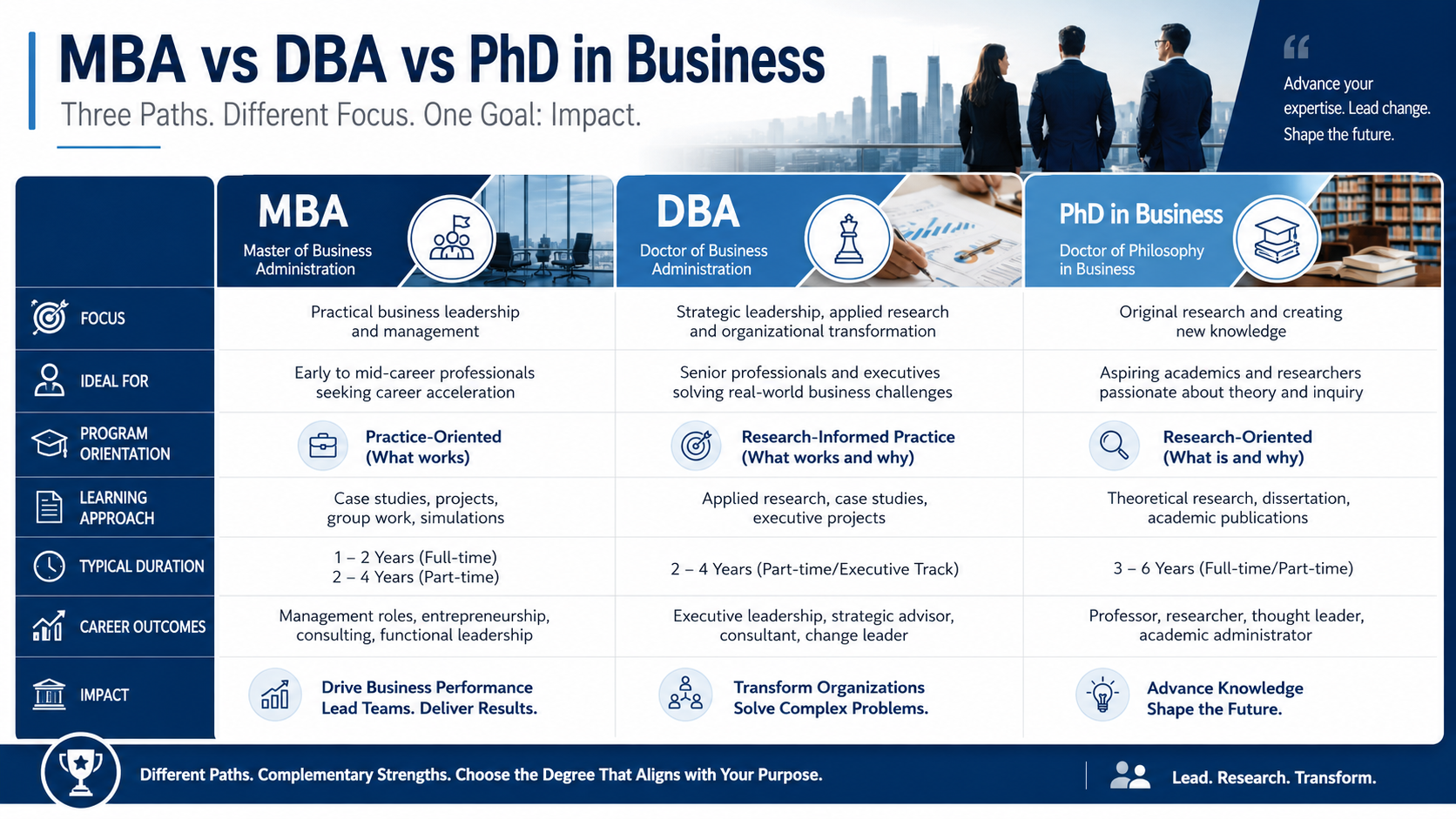
A DBA, sort of, merges advanced research skills with real-world business needs. And this combination helps organizations make decisions based on evidence, not just hunches.
More and more companies seem to prefer professionals who can spell out not only which decision to take, but also why it works, using measurable results and strategic analysis.
The Growing Complexity of Modern Business Challenges
Businesses today operate in environments that change quickly. Organizations must adapt to new technologies, shifting consumer behavior, workforce expectations, and economic uncertainty at the same time.
These challenges affect businesses across every industry.
Digital Transformation Pressures
Many companies invest heavily in artificial intelligence, automation, and digital systems. However, technology alone does not guarantee success.
Without strong leadership and clear implementation strategies, digital transformation projects often fail to produce measurable results.
Organizations need leaders who can:
-
Analyze operational gaps
-
Evaluate technology adoption
-
Improve implementation strategies
-
Align digital initiatives with business goals
DBA professionals help companies approach digital transformation strategically instead of reactively.
Workforce and Leadership Challenges
Employee burnout, leadership communication gaps, hybrid work environments, and retention issues continue to create pressure for organizations worldwide.
These problems directly affect:
-
Productivity
-
Employee engagement
-
Workplace culture
-
Customer experience
-
Long-term business growth
DBA professionals often study organizational behavior and leadership systems to identify operational weaknesses that affect employee performance and morale.
Data Overload and Poor Decision-Making
Businesses now collect more information than ever before. However, many organizations still struggle to turn data into an actionable business strategy.
Poor data interpretation can lead to:
-
Delayed decisions
-
Weak strategic planning
-
Misaligned business goals
-
Inefficient operations
-
Increased operational costs
DBA professionals use research-driven analysis to help organizations interpret data more effectively and improve strategic decision-making.
Global Uncertainty and Organizational Risk
Economic instability, cybersecurity threats, supply chain disruptions, and changing regulations continue to create uncertainty for business leaders.
Organizations now need professionals who can:
-
Analyze risks carefully
-
Identify operational weaknesses
-
Develop long-term strategies
-
Improve organizational adaptability
DBA-trained professionals approach these challenges systematically through research, evidence collection, and strategic evaluation.
Example of a DBA Professional in Action
A mid-sized retail company kind of struggled with high employee turnover across a few locations. At first, leadership thought it was mostly salary-related, but when they talked to employees, it turned out there were more operational issues going on. Things like inconsistent leadership practices and communication that just weren’t clear enough or were even scattered.
Then the company brought in a DBA-trained consultant who could dig into it, using a research-grounded approach. The consultant went through workforce data, checked operational systems, and interviewed management across several stores. After looking at it all, the findings pointed to a fairly straightforward pattern: places with structured leadership training had noticeably lower turnover.
Based on these findings, the company introduced a standardized management development program across all locations.
Within one year:
-
Employee turnover dropped by 18%
-
Customer satisfaction scores improved
-
Team productivity increased across multiple regions
This example shows how DBA professionals transform business challenges into measurable opportunities through structured analysis and evidence-based leadership.
Quick Research Findings Summary
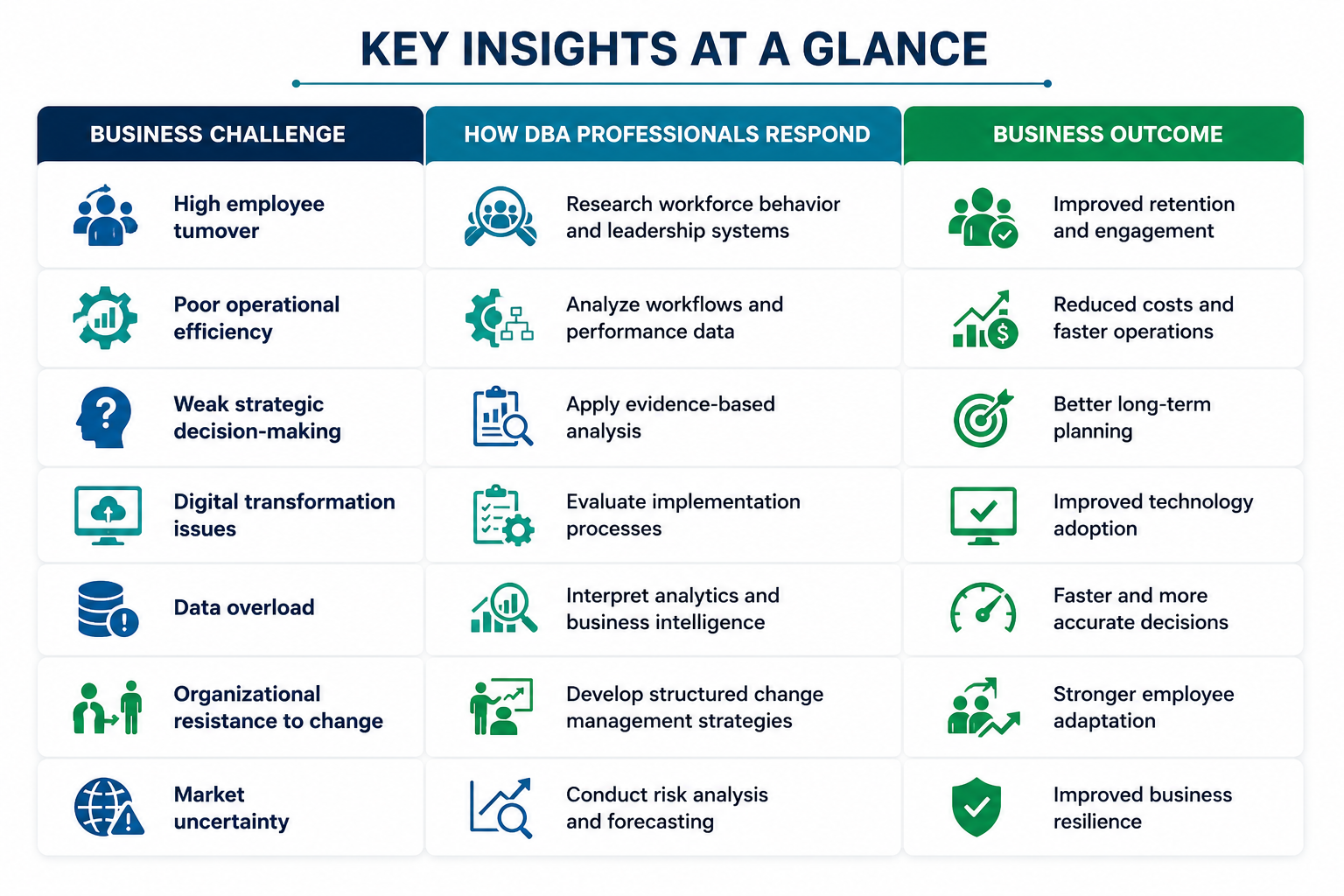
Why Businesses Increasingly Value DBA Professionals
Modern organizations need leaders who can combine analytical thinking with practical execution.
DBA professionals help businesses:
-
Solve complex operational problems
-
Improve organizational performance
-
Lead research-driven transformation
-
Build long-term business strategies
-
Support innovation and adaptability
As industries continue to evolve, companies increasingly depend on leaders who can make informed decisions using both research and real-world business insight.
Organizations no longer need leaders who react only to short-term problems. They need professionals who can identify deeper operational issues, evaluate evidence carefully, and create sustainable business solutions.
This is the growing role of DBA professionals in modern business leadership.

 Arabic
 French
 Spanish
 Portuguese
 Deutsch
 Turkish
 Dutch
Dutch
 Italiano
 Russian
 Romaian
 Portuguese (Brazil)
 Greek
Greek