In heavy lifting operations, choosing the right equipment is essential for maintaining load stability, protecting materials, and supporting safe handling practices. Two commonly used lifting devices are the spreader beam and the lifting beam. Although they may appear similar at first glance, their design, load distribution method, and applications are quite different. Understanding these differences helps industries select the right lifting solution for construction, marine, oil and gas, manufacturing, and logistics operations.
Understanding a Spreader Beam
A spreader beam is a lifting attachment designed to distribute the load across multiple lifting points while minimizing compressive force on the object being lifted. It uses two or more slings connected from the top rigging point to the ends of the beam.
The main purpose of a spreader beam is to increase the distance between lifting slings. This configuration reduces the angle stress created during lifting and helps prevent damage to wide or fragile loads.
Common Applications of a Spreader Beam
Industries often use a spreader beam for lifting:
- Large steel structures
- Pipes and cylindrical equipment
- Shipping containers
- Offshore modules
- Heavy machinery components
Because the slings remain nearly vertical, the spreader beam improves balance and reduces side loading forces.
Key Benefits of a Spreader Beam
Better Load Distribution
A properly engineered spreader beam evenly distributes the weight across lifting points, reducing concentrated stress.
Reduced Sling Angle Pressure
Vertical sling positioning minimizes inward compression on the load, making it suitable for delicate or oversized equipment.
Improved Stability
Wide lifting configurations offer greater balance during transportation and installation tasks.
What Is a Lifting Beam?
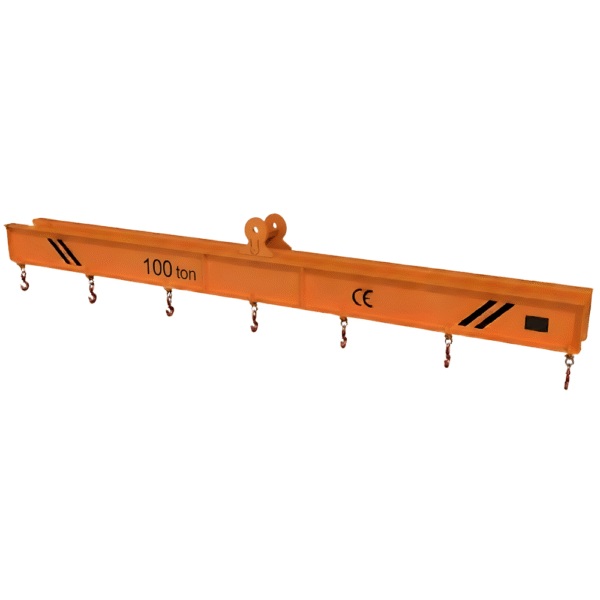
A lifting beam is another below-the-hook lifting device, but it works differently from a spreader beam. Instead of using compression forces, a lifting beam handles loads primarily through bending.
In this setup, the lifting point is usually positioned above the beam, while the load hangs below through one or more attachment points. Lifting beams are compact and ideal for situations where overhead clearance is limited.
Where Lifting Beams Are Commonly Used
Lifting beams are frequently used in:
- Warehouses
- Manufacturing facilities
- Equipment assembly plants
- Short-span lifting applications
- Indoor crane operations
Unlike a spreader beam, lifting beams are often selected when lifting loads from a single central point.
Spreader Beam vs Lifting Beam: Major Differences
While both devices assist with safe material handling, their operational differences are significant.
Load Handling Method
A spreader beam works under compression, keeping sling angles controlled and maintaining load stability. A lifting beam operates under bending stress and transfers the load through the beam itself.
Lifting Configuration
A spreader beam typically uses top and bottom slings connected at multiple points. A lifting beam usually has one lifting lug at the top and several load attachment points underneath.
Space Requirements
Spreader Beam
A spreader beam requires more vertical lifting space because of the upper sling arrangement.
Lifting Beam
Lifting beams are more compact and perform well in facilities with restricted headroom.
Best Use Cases
A spreader beam is ideal for long, wide, or sensitive loads that require balanced lifting. Lifting beams are better suited for compact loads and controlled indoor lifting tasks.
Choosing the Right Beam for Your Operation
Selecting between a spreader beam and a lifting beam depends on several operational factors.
Consider the Load Dimensions
Large and uneven loads often benefit from a spreader beam because it reduces side pressure and distributes force more evenly.
Evaluate Lifting Height
If crane clearance is limited, a lifting beam may provide a more practical solution.
Check Weight Capacity
Every lifting attachment should meet the required working load limit and comply with industry safety standards.
Assess Environmental Conditions
For offshore, construction, and heavy industrial projects, a spreader beam often delivers better control for oversized equipment handling.
Why Engineered Lifting Solutions Matter
Using improperly designed lifting equipment can lead to load imbalance, equipment damage, and operational delays. Professionally manufactured lifting systems provide safer handling, improved efficiency, and compliance with industrial lifting standards.
Welmeqs Engineering and Lifting Solutions FZE LLC delivers reliable lifting equipment solutions designed for demanding industrial environments. Whether your operation requires a customized spreader beam or a high-capacity lifting beam, their engineered products support safe and efficient lifting performance across multiple industries.




 English
 Arabic
 Spanish
 Portuguese
 Deutsch
 Turkish
 Dutch
Dutch
 Italiano
 Russian
 Romaian
 Portuguese (Brazil)
 Greek
Greek